August 27, 2026
Overall Abundance Score: 76/100
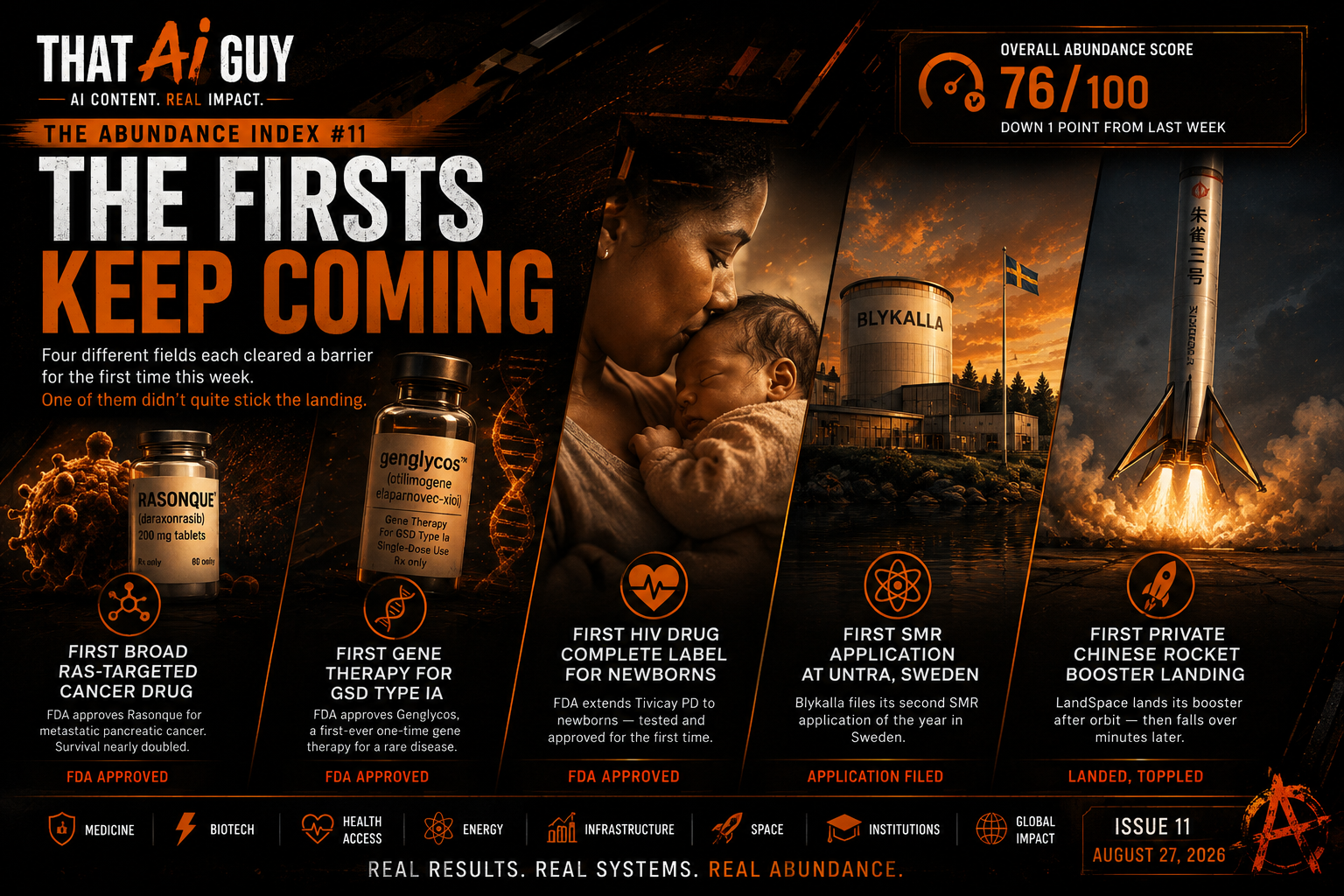
Status: Down one point from last week’s 77. This week’s gains came from institutions and companies doing something for the first time — a first broad RAS-targeted cancer drug, a first gene therapy for a disease that had none, a first landing by a private Chinese rocket company — rather than from any single dramatic breakthrough. The score holds roughly steady because the wins are real and well-documented, but two of the five stories carry unusually concrete failure modes: a rocket booster that toppled minutes after landing, and a nuclear plant that is, for now, just a filed application.
Executive Summary
This week’s clearest story came from the FDA, which on August 26 approved Rasonque (daraxonrasib), Revolution Medicines’ first broad RAS-targeted medicine for metastatic pancreatic adenocarcinoma — the most common and among the deadliest forms of pancreatic cancer. In a 500-patient trial, previously treated patients lived a median of 13.2 months on the drug versus 6.7 months on standard chemotherapy, and the approval landed six and a half months ahead of the FDA’s own review deadline. That is a genuine survival gain for a cancer that has had almost nothing to offer beyond chemotherapy, delivered faster than a drug of this significance typically moves.
The rest of the week filled in around the same idea: institutions and companies reaching populations or capabilities they hadn’t reached before. On August 19, the FDA gave Ultragenyx accelerated approval for Genglycos, the first-ever gene therapy for glycogen storage disease type Ia, a one-time treatment aimed at the disease’s actual genetic cause rather than the round-the-clock cornstarch regimen patients have relied on until now. On August 25, the FDA extended Tivicay PD, a better class of HIV drug, to newborns for the first time. That same day, in Sweden, reactor developer Blykalla filed its second application this year for a small, lead-cooled nuclear plant, this one at Untra in Tierp municipality. And on August 18, LandSpace’s Zhuque-3 became the first privately built Chinese rocket to land its booster after reaching orbit — before the booster caught fire and toppled over a few minutes later.
None of this is finished, and one story is an outright partial failure. Genglycos carries a $2.7 million price tag and was approved on symptom-reduction data, not confirmed long-term outcomes; two more years of data are still owed to the FDA. Tivicay PD’s newborn approval rests on a 48-patient trial, a small base by any standard. Blykalla’s Untra proposal is a submitted application, not a funded or approved plant, and still needs sign-off from Sweden’s safety regulator, a court, and a municipality before anything gets built. And Zhuque-3’s booster, despite landing upright, was damaged by its own leftover propellant and fell over, leaving LandSpace’s claim to genuine reusability unproven.
This was a week about institutions and companies extending existing tools to people, diseases, and capabilities that had been left out by default, not about a single new discovery. Some of those extensions landed cleanly. At least one of them literally did not.
Breakthrough of the Week
A cancer with no aimed drug gets one, months ahead of schedule
What happened: On August 26, 2026, the FDA approved Rasonque (daraxonrasib), developed by Revolution Medicines, as the first broad RAS-targeted medicine for metastatic pancreatic adenocarcinoma. The once-daily pill targets multiple forms of the RAS protein, a key driver of tumor growth in most pancreatic cancer patients. In a randomized, 500-patient trial, previously treated patients lived a median of 13.2 months on Rasonque versus 6.7 months on standard chemotherapy. The approval came six and a half months ahead of the FDA’s own user-fee deadline.
Why it matters: Pancreatic adenocarcinoma accounts for 90 to 95% of the roughly 67,000 new pancreatic cancer cases diagnosed in the US each year, and despite representing only about 3.2% of all cancer diagnoses, it accounts for a disproportionate share of cancer deaths, the product of late detection, aggressive growth, and until now, no targeted treatment option at all. RAS mutations also drive a large share of solid tumors generally, so a validated broad RAS inhibitor reaching approval sets a template other RAS-driven cancers can follow.
What friction it removes: Patients whose pancreatic cancer progressed past first-line treatment previously had chemotherapy as essentially their only option. Rasonque gives them a second option that nearly doubles survival, reaching them faster than a drug this significant typically would thanks to Breakthrough Therapy and Orphan Drug designations, Priority Review, and the FDA’s Commissioner’s National Priority Voucher pilot program.
What to keep sober: Rasonque’s side-effect profile is real: rash, diarrhea, stomatitis, nausea, fatigue, vomiting, abdominal pain, edema, decreased appetite, and hemorrhage were all common in the trial. A median survival gain of 6.5 months is meaningful, not curative. This is a materially better second-line option for one specific, deadly cancer, not a solved cancer.
The abundance signal: An entire class of previously non-targetable RAS-driven tumors now has a proof-of-concept, approved drug, reviewed on a timeline that ran months ahead of the FDA’s own deadline. Genuine survival benefit paired with institutional speed is a pattern the Index has tracked elsewhere; this week it showed up in one of oncology’s hardest problems.
Source: FDA, August 26, 2026
Major Developments
1. A first-ever gene therapy reaches a disease that had none
On August 19, 2026, the FDA granted accelerated approval to Genglycos, Ultragenyx’s one-time gene therapy for glycogen storage disease type Ia (GSDIa) in patients eight and older — the first FDA-approved treatment designed to address the disease’s underlying cause rather than just manage its symptoms. GSDIa leaves patients unable to stabilize blood sugar between meals; without treatment, that typically means ingesting a cornstarch slurry every four hours, day and night, indefinitely. Genglycos delivers a functional copy of the missing gene to the liver in a single infusion, and trial data showed it let patients meaningfully reduce that cornstarch regimen.
What to keep sober: The therapy carries a wholesale acquisition cost of $2.7 million per patient, and it was approved on the accelerated pathway, based on reduced cornstarch intake rather than confirmed long-term clinical outcomes; Ultragenyx still owes the FDA two more years of data (it plans ten) to convert this to a full approval. This is real, meaningful progress for an ultra-rare disease with no prior good options, not evidence that gene therapy has become affordable or routine.
The abundance signal: A disease that previously had only round-the-clock dietary management now has a one-time treatment aimed at its actual genetic cause. That is a different category of progress than a better pill: it is the first working example, for this specific disease, that the underlying problem itself is treatable.
Source: BioPharma Dive, August 20, 2026
2. A better HIV drug finally reaches the youngest patients
On August 25, 2026, the FDA approved Tivicay PD (dolutegravir), ViiV Healthcare’s oral-suspension formulation, for newborns from birth to under four weeks old weighing at least 2 kilograms, in combination with other antiretrovirals. It is the first second-generation integrase inhibitor — a drug class with a meaningfully higher barrier to viral resistance than older HIV medications — approved for this age group. The approval rested on the Phase 1 IMPAACT 2023 trial, which evaluated the drug in 48 HIV-exposed newborns.
What to keep sober: Forty-eight newborns is a small trial population, typical for this kind of neonatal pharmacokinetic study but still a narrow evidence base; longer-term outcomes in this age group will keep accumulating over time. This is an incremental extension of an existing, well-established drug, not a new mechanism or a cure.
The abundance signal: Newborns exposed to HIV have historically been treated with older, lower-barrier-to-resistance drugs simply because the better ones hadn’t been tested in infants that young. Closing that gap doesn’t require inventing anything new; it requires running the trial and reaching the age group that had been left out by default.
Source: Contagion Live, August 25, 2026
3. A private Chinese rocket lands for the first time — and then falls over
On August 18, 2026 (August 19 Beijing time), LandSpace’s Zhuque-3 rocket delivered a satellite to orbit and landed its first-stage booster on solid ground using landing legs, becoming the first privately built Chinese company to recover an orbital-class rocket booster. It was only the second Chinese orbital rocket landing overall, after a state-owned Long March 10B caught itself in a net at sea in July. Zhuque-3 is designed to be reusable at least 20 times and closely resembles SpaceX’s Falcon 9 in size and lift capacity. This item falls just outside this issue’s usual seven-day window but is included because the failure sequence that followed the landing is directly relevant to assessing how real this milestone is.
What to keep sober: The booster stood upright immediately after touchdown, but residual leftover propellant then ignited near its base, damaging a landing leg; the stage toppled over minutes later. LandSpace says it may be able to salvage undamaged engines and grid fins even if the booster itself cannot be repaired and reflown, and the company’s first landing attempt in December 2025 ended in an explosion. This was real technical progress, not a clean, repeatable success yet.
The abundance signal: Reusability is what took the cost of reaching orbit down by an order of magnitude once one company proved it could be done routinely. A second country, and now a private company outside that first one, demonstrating the core landing maneuver — however imperfectly — is how that cost curve eventually becomes an industry norm rather than one company’s advantage.
Source: Space.com, August 19, 2026
4. Sweden’s small nuclear reactor pipeline gets a second entry
On August 25, 2026, Swedish reactor developer Blykalla submitted an application to the Swedish government for a nuclear power plant at Untra, in Tierp municipality, featuring up to eight lead-cooled SEALER small modular reactors with a combined capacity of up to 440 MWe. It is Blykalla’s second such application this year, following a six-unit proposal submitted in May for a different site, and the fourth overall application filed under a Swedish state-aid scheme for new nuclear power.
What to keep sober: This is a submitted application, not an approved, funded, or under-construction plant. It still needs sign-off from Sweden’s Radiation Safety Authority, the Land and Environmental Court, and Tierp municipality, and Blykalla’s own target for its first commercial reactor is “the early 2030s” — years away, contingent on all of the above.
The abundance signal: Lead-cooled small modular reactors are designed to be sited closer to industry and in smaller, inland communities where traditional large-scale nuclear has never been feasible. A second application in three months, in a second municipality, is a sign that a new category of nuclear power is being taken seriously enough to actually file the paperwork, not just discuss it.
Source: World Nuclear News, August 25, 2026
Why This Matters
The connecting thread this week was inclusion, not invention. A cancer with no targeted drug got one. A disease with no gene therapy got one. Newborns got access to a drug class adults have had for years. A second country’s private sector joined a club only one company had reliably belonged to. A nuclear technology aimed at communities traditional reactors could never reach filed to expand its footprint. In each case, something that already existed for someone, somewhere, moved to cover a population or a capability that had been left out.
That inclusion is still provisional almost everywhere it appears. Genglycos’s accelerated approval and $2.7 million price tag mean it will reach a vanishingly small number of the patients who could theoretically benefit, for now. Tivicay PD’s newborn data comes from 48 patients. Blykalla’s application is a filing, not a plant, and sits behind years of regulatory and municipal review. And Zhuque-3’s landing, the week’s most visually dramatic story, ended with the booster on fire and on its side — a reminder that “first” and “solved” are different words.
Abundance Index Score
This week’s score: 76/100
Last week: 77/100
Change: −1
Why the score fell: This week’s stories are individually credible and well-documented, but two of them carry unusually concrete failure modes rather than the more abstract caveats (”needs confirmatory data,” “needs more funding”) that usually temper good news in this newsletter. A rocket booster that visibly toppled and a nuclear plant that exists only as a filed application are more grounded, harder-to-spin setbacks than most weeks produce.
Why the score is not lower: Three completed, evidence-backed FDA approvals in a single week — one of them, Rasonque, with a genuinely strong survival benefit and a review that ran months ahead of deadline — is a real and durable set of gains regardless of how the rocket landing turned out. Medicine did its job cleanly this week even where space and energy did not.
Score interpretation: A high-70s score describes a week where the clearest wins came from institutions extending proven tools to people who’d been excluded from them, alongside enough hard evidence of what still doesn’t work to keep the picture honest.
Looking Ahead
Does Rasonque’s overall-survival benefit hold up as more patients are treated, and do other RAS-driven cancers see similar targeted drugs follow its path through the FDA?
Does Ultragenyx’s required two years of confirmatory data validate Genglycos’s accelerated approval, and does its price ever move within reach of more of the patients who need it?
Does the FDA reach a decision this week on Gilead’s bictegravir/lenacapavir combination pill, whose target action date is today, August 27?
Does LandSpace successfully refly a recovered Zhuque-3 booster within the roughly six-month window it has set for itself, or does this landing’s damage prove harder to repair than expected?
Does Blykalla’s Untra application clear Sweden’s safety regulator, courts, and municipal approval, or does it join the pipeline of filed-but-unbuilt reactor proposals?
Closing Reflection
A cancer with no aimed drug gets one, six months ahead of schedule.
A cornstarch alarm that rings every four hours gets its first real competitor.
A newborn gets the same drug protection adults have carried for years.
A booster lands upright, catches fire, and falls over anyway.
A reactor the size of a small town asks Sweden’s permission a second time.
None of these are finished. Each is a door that did not exist a week ago.
Source Notes and Fact-Check
Rasonque (daraxonrasib) FDA approval for metastatic pancreatic adenocarcinoma, based on a 500-patient trial showing 13.2 vs. 6.7 month median overall survival: verified current, FDA, August 26, 2026.
Genglycos gene therapy accelerated approval for glycogen storage disease type Ia, approved August 19 and reported August 20, with a $2.7 million wholesale acquisition cost: falls slightly outside this issue’s seven-day window but included as this week’s clearest first-in-category approval; verified current, BioPharma Dive, August 20, 2026.
Tivicay PD (dolutegravir) approval for newborns with HIV, based on the 48-patient IMPAACT 2023 trial: verified current, Contagion Live, August 25, 2026.
LandSpace Zhuque-3 first-stage landing on August 18–19 and subsequent toppling: falls slightly outside this issue’s seven-day window but included because the failure sequence is essential context for the milestone itself; verified current, Space.com, August 19, 2026, with landing-damage detail confirmed via NASASpaceFlight, August 2026.
Blykalla’s second SEALER small modular reactor application, for a plant at Untra in Tierp municipality with up to 440 MWe combined capacity: verified current, World Nuclear News, August 25, 2026.