September 18, 2026
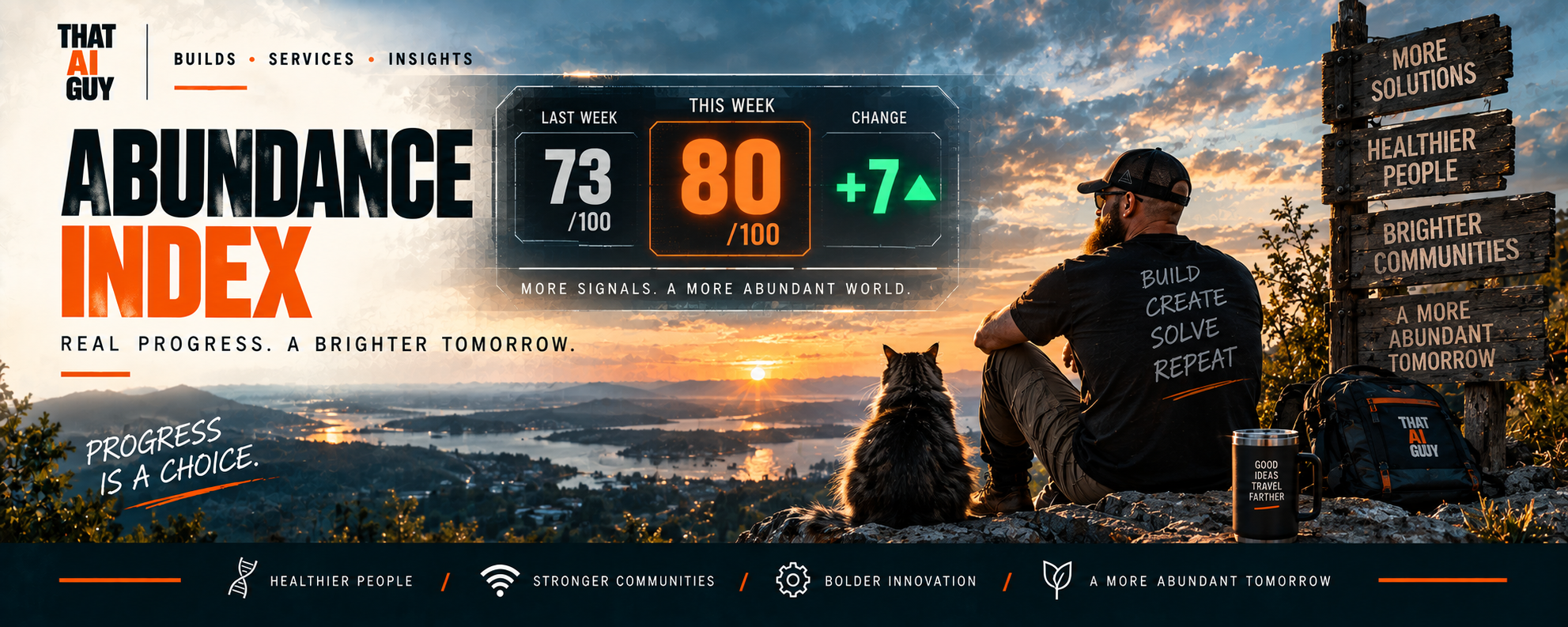
Overall Abundance Score: 80/100
Status: Up seven points from last week’s 73. Last week had five promising stories and zero finished ones. This week has an actual, no-asterisks approval sitting at the top, plus a second regulatory yes right behind it.
Executive Summary
Start with the kid who couldn’t get a yes until yesterday. On September 17, the FDA gave full approval to Fayuvi, a one-time gene therapy from Ultragenyx, for Sanfilippo syndrome type A — a disease that, until this week, had no approved treatment of any kind, just symptom management while it progressively erased a child’s cognitive and motor development. Not accelerated approval. Not a conditional nod pending more data. Full approval, based on a trial where treated kids held onto cognitive ground that untreated kids reliably lose. That’s the rarest kind of abundance story: the one that’s actually finished.
Everything else this week is a smaller version of the same theme — institutions saying yes instead of finding a reason to wait. The FDA also expanded sevabertinib, an existing lung cancer pill, into the front line, meaning a newly diagnosed patient with the right mutation can take it first instead of failing two rounds of chemo to earn the privilege. At a cancer conference in Seoul, two unrelated drug companies — one licensed by GSK, one by Roche — presented near-identical results in relapsed small-cell lung cancer, both cutting the risk of death by roughly half against the old standard chemo. Neither drug is approved yet, but when two competitors chasing the same target land on the same number independently, that’s a stronger signal than either result alone. Meanwhile, Argentina’s government signed off on satellite kits for 6,000 rural schools instead of waiting on a fiber rollout it was never going to finish this decade, Cornell researchers got dyed wool to distill drinkable water out of saltwater using nothing but sunlight, and a mobile-robot maker in Texas became one of the first companies cleared through the FCC’s new hardware supply-chain review — proof that “no” isn’t the only setting on that particular dial.
Now, if your prior is that every regulatory approval this week must be a rubber stamp and every “yes” is secretly a “yes, but we didn’t check very hard” — fair, that prior exists for a reason, and institutions have earned some of that suspicion honestly. But that’s not what happened here. The two lung cancer drugs are trial data, not labels yet — global confirmatory trials are just getting underway, and the GSK drug showed a real spike in lung inflammation (11.7% of patients versus 1.9% on chemo) that needs watching, not waving away. The wool desalination is a lab bench result on clean seawater, with zero field deployment and no cost-per-liter number yet. Argentina’s Starlink deal is a signed agreement with a four-batch rollout plan and no installation map published — signed isn’t the same as delivered. And FCC “conditional approval” is a probationary status tied to ongoing manufacturing commitments, which could tighten later just as easily as it loosens. Skepticism about institutions is usually well-earned. This week it just doesn’t happen to be the whole story.
So: a genuinely good week, with one story that’s all the way done and several more that are close enough to take seriously. “Close enough to take seriously” and “already true” are different claims, and this newsletter tries hard not to confuse them, even when the temptation to declare victory is sitting right there.
Breakthrough of the Week

Sanfilippo syndrome just got its first-ever yes
What happened: On September 17, the FDA granted full approval to Fayuvi (rebisufligene etisparvovec-hopf) for pediatric patients with mucopolysaccharidosis type IIIA — Sanfilippo syndrome type A — a rare, fatal, progressive neurodegenerative disease sometimes described as childhood Alzheimer’s. It’s a one-time intravenous infusion that uses a modified virus (AAV9) to deliver a working copy of the gene these kids are missing, letting their cells finally break down a substance that otherwise builds up and destroys brain and nervous system function.
Why it matters: Until this week, there was no approved treatment that touched the actual disease — only ways to manage symptoms while a child lost language, cognition, and motor skills on a predictable, brutal timeline. This is Ultragenyx’s second approved gene therapy, and the first drug of any kind ever approved specifically for MPS IIIA.
What friction it removes: Families used to get a diagnosis and a countdown. Now they get a diagnosis and an actual intervention, administered once, in a hospital, rather than a lifetime prescription regimen that doesn’t exist yet.
What to keep sober: This is a rare disease with a small trial population, evaluated against a historical, not concurrent-randomized, control group. The therapy carries real risks, including a warning for thrombotic microangiopathy and the long-term theoretical risk that comes with any AAV gene therapy — the inserted genetic material integrating somewhere it shouldn’t. “Maintained or improved cognitive function” is a genuinely good outcome for this disease. It is not a cure that reverses damage already done, and nobody involved is claiming otherwise.
The abundance signal: A disease with zero approved options has one now. That’s not incremental. That’s the floor moving.
Source: FDA, September 17, 2026
Major Developments
1. Two competing drug companies solved the same lung cancer problem, separately, and got almost the same answer
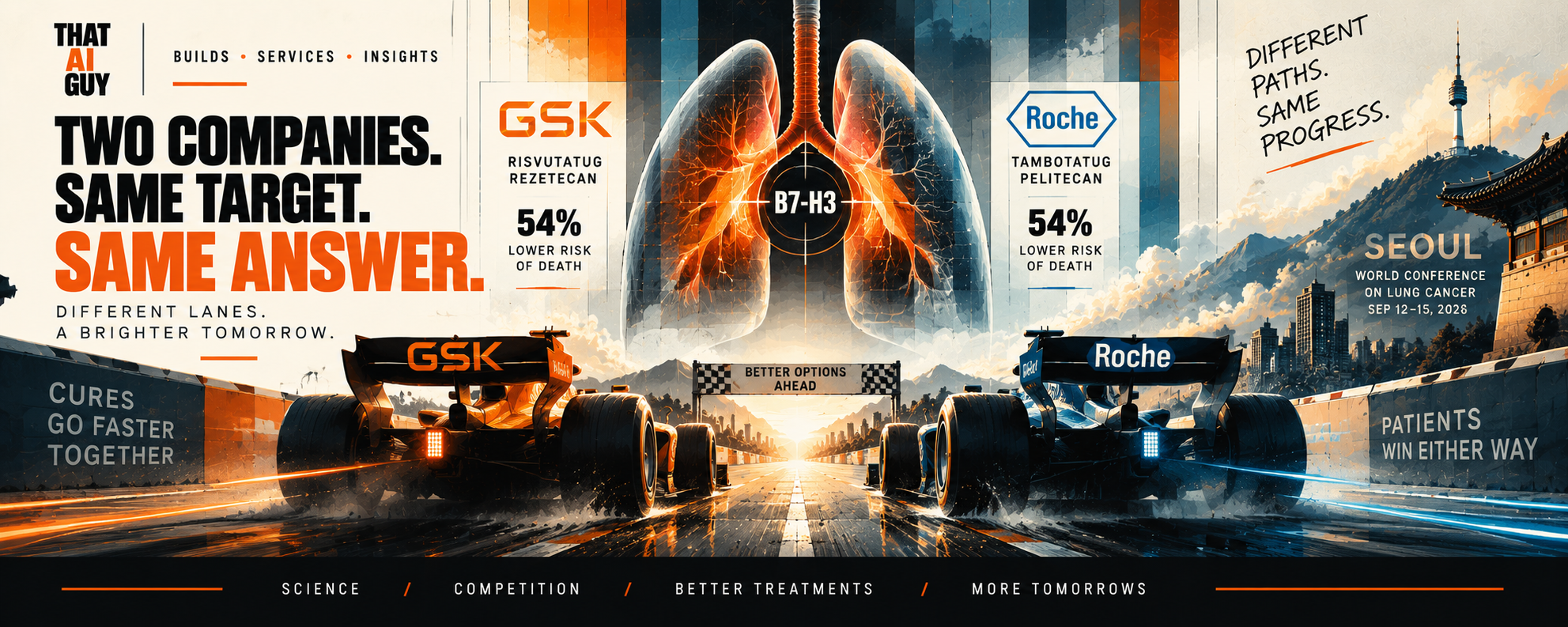
At the World Conference on Lung Cancer in Seoul (September 12–15), two different antibody-drug conjugates — both aimed at a protein called B7-H3 that shows up heavily on small-cell lung cancer tumors — reported phase 3 results in patients whose cancer came back after standard chemo. GSK’s risvutatug rezetecan cut the risk of death by 54% against topotecan, stretching median survival from 10.3 to 18.5 months, with the response rate jumping from 12.6% to 58.3%. MediLink/Roche’s tambotatug pelitecan, tested in a separate 451-patient trial, produced almost the same shape of result: survival from 9.4 to 13.3 months, response rate from 9.7% to 59.1%. Two labs, two licensing deals worth well over $2 billion combined, chasing the same molecular target, landing in the same neighborhood. Somewhere, a naming committee looked at “risvutatug rezetecan” and decided it needed no further workshopping. Fine. Nobody’s swallowing the name.
What to keep sober: Neither drug has FDA approval — this is trial data on the way to a filing, not a prescription anyone can write yet, and both trials enrolled exclusively Asian patients in China, so global confirmatory trials, already underway for GSK’s drug, still need to show the effect holds elsewhere. The GSK drug’s inflammation signal — interstitial lung disease in nearly 12% of patients versus under 2% on chemo — is the kind of detail that decides whether this becomes a new standard of care or a cautionary footnote.
The abundance signal: Independent convergence is a better sign than either result on its own. When two competitors racing each other for market share arrive at nearly the same number from different directions, that’s what a real biological effect looks like, not a statistical fluke that got a good headline.
Sources: OncLive, September 12, 2026 and OncLive, September 13, 2026
2. A lung cancer pill moved from last resort to first option
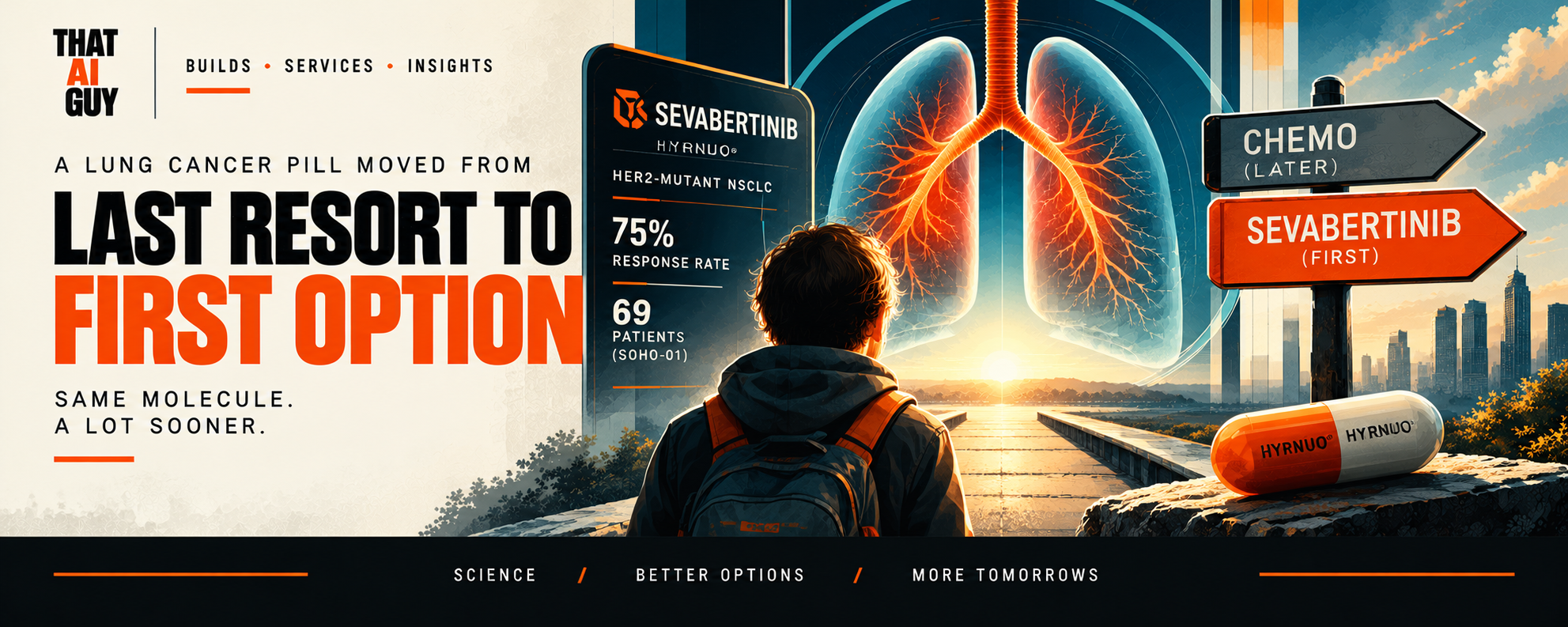
On September 9, the FDA expanded its accelerated approval of sevabertinib (Hyrnuo) to cover newly diagnosed patients with HER2-mutant non-small cell lung cancer, based on a 69-patient cohort of the SOHO-01 trial showing a 75% response rate with no prior treatment. The drug was already approved in November 2025, but only for patients who’d already failed something else first.
What to keep sober: This is still accelerated approval, meaning it’s conditional on a confirmatory trial eventually proving real clinical benefit, not just tumor response. The drug’s label carries real warnings — lung inflammation, liver toxicity, heart function, eye toxicity among them.
The abundance signal: The molecule isn’t new. What changed is how soon a patient with the right mutation gets to use it — one less round of chemo standing between diagnosis and the treatment that actually targets the problem.
Source: The ASCO Post, September 9, 2026
3. Dyed wool turns saltwater into something you can drink, no grid required
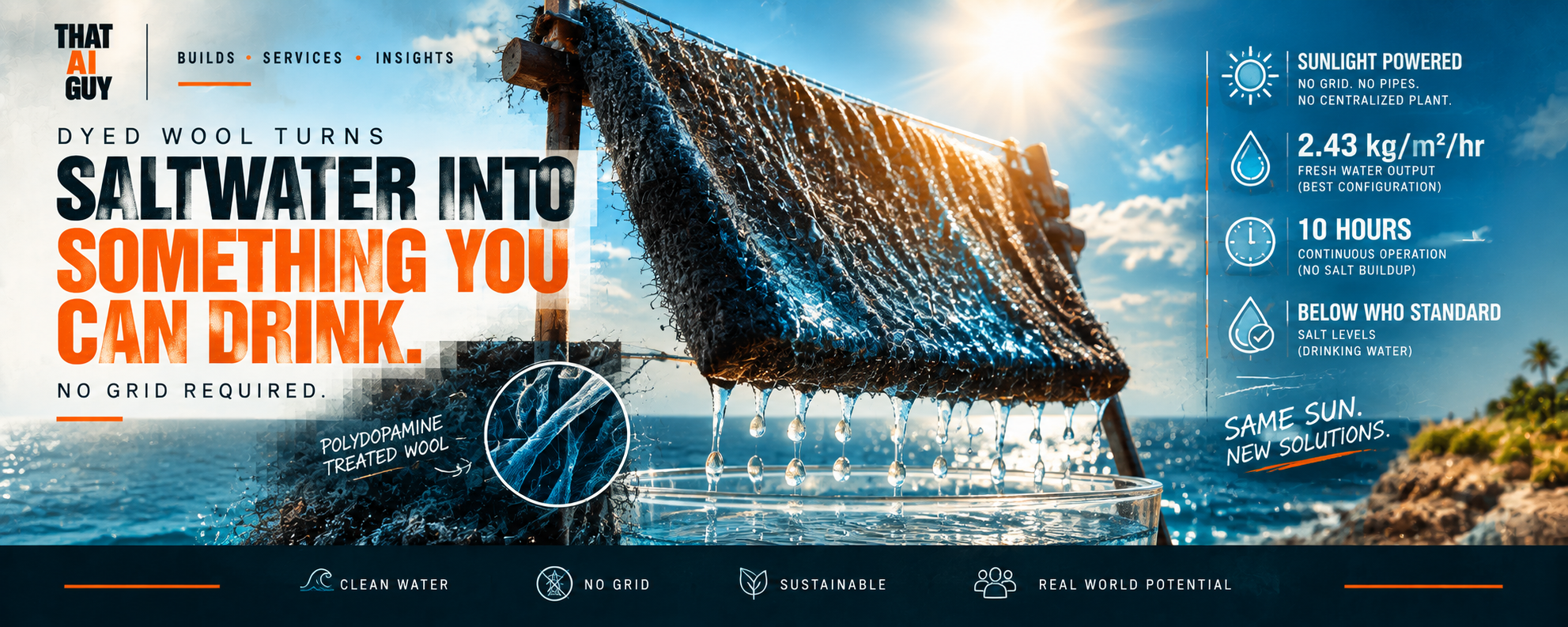
Cornell researchers dyed wool with polydopamine — a polymer that behaves a bit like the pigment in mussel shells — and used it to pull drinkable water out of saltwater using nothing but sunlight. In its best configuration, the treated wool produced 2.43 kilograms of fresh water per square meter of fabric per hour, ran ten straight hours without salt buildup clogging the material, and delivered water with salt levels comfortably under the WHO’s drinking standard. The work, led by Cornell’s Larissa Shepherd, published September 6 in Advanced Science. Somebody spent a career studying textile dye chemistry and ended up with a plumbing solution. That’s the job sometimes.
What to keep sober: This is a lab bench result on clean seawater under a solar simulator, not a field deployment. Nobody’s tested it yet on actual rainwater or wastewater, there’s no cost-per-liter comparison against existing desalination methods, and the researchers themselves frame this as a feasibility proof, not a product.
The abundance signal: No pipes, no grid, no centralized plant — just fabric and sunlight. That’s the profile of a technology that could reach a community with no infrastructure at all, rather than one that requires the infrastructure to already exist before it helps anyone.
Source: Cornell Chronicle, September 9, 2026

4. Argentina bought internet for its rural schools instead of promising fiber someday
On September 8, Argentina’s Ministry of Human Capital and telecom regulator ENACOM signed a deal with Starlink to install 6,000 connectivity kits across rural and isolated schools, rolling out in four batches of 1,000, 1,000, 2,000, and 2,000 kits. Each kit comes with two years of high-speed satellite service and up to five terabytes of data per school. Total cost to the Argentine government: roughly $21.9 million. Some Argentine coverage framed this as Starlink “donating” internet to schools, which is a creative way to describe a government writing a $21.9 million check. Donations, as a rule, don’t come with an invoice. That’s a marketing detail, not a scandal — the schools still get connected either way.
What to keep sober: This is a signed agreement, not a finished rollout — neither Starlink nor the ministries have published an installation timeline or a province-by-province map yet. “Signed convenio” has a way of turning into “delayed convenio” in infrastructure projects everywhere, not just Argentina, and the actual value of the deal is still being argued over in the Argentine press.
The abundance signal: This is the personal-liberty lens in its plainest form: a government chose to buy an already-existing, permissionless technology off the shelf rather than commit another decade to fiber it was never going to finish building to the places that need it most.
Source: TeslaNorth, September 8, 2026

5. A warehouse robot maker found out the FCC’s new gate has a “yes” setting
ANSCER Robotics, maker of the AR250, AR650, and AR1250 autonomous mobile robots used in warehouses and factories, secured Conditional Approval from the FCC effective September 18 — one of the first companies, alongside Husqvarna, to clear the Commission’s newer Robotic Devices review, part of a supply-chain security program added to the agency’s Covered List rules earlier this year. If your instinct is that a new federal review process exists mainly to slow things down, that instinct isn’t crazy — plenty of them do exactly that. But a review that hands out actual approvals, on a published timeline, to a company that isn’t a giant, is a review doing its job rather than just guarding a door.
What to keep sober: “Conditional” is doing real work in that phrase — this is a probationary authorization tied to ongoing U.S.-manufacturing and reporting commitments, not a permanent clearance, and it’s a narrow story limited to one mid-size robotics maker’s warehouse products. Whether this stays a genuine on-ramp or hardens into a moat only well-funded companies can clear is a real open question, not a solved one.
The abundance signal: A published, navigable pathway to compliance beats an opaque ban. A regulator that says “yes, conditionally” instead of just “no” is still doing its job better than one that doesn’t say anything at all.
Source: RoboticsTomorrow, September 18, 2026
Why This Matters
Look at the thread running under all six stories: nothing here is a brand-new invention. It’s institutions running out of reasons to say no to things that already existed. The FDA didn’t discover gene therapy this week — it approved a specific one, for a specific disease, that had been sitting in trials waiting for a decision. It didn’t invent sevabertinib — it just let doctors reach for it sooner. Argentina didn’t invent satellite internet — it signed a check for it instead of waiting on fiber. The FCC didn’t invent supply-chain security — it built a door that isn’t just locked. Even the trial data out of Seoul is two companies proving a target that was already hypothesized. Abundance, more often than the headlines suggest, looks less like a lightning bolt and more like a permission slip finally getting signed.
Here’s the part where the cynic in the room gets to be right, too: permission slips can get rescinded, or never fully honored. Sanfilippo families still have to navigate access and cost for a therapy that just barely exists. The lung cancer drugs still need to clear FDA review and prove the inflammation risk is manageable. Argentina’s schools still need the kits to actually show up on schedule. “Conditional approval” from the FCC is a status, not a guarantee — ask any company whose “conditional” designation quietly became “denied” a year later. Institutions saying yes is real progress. It is not the same as institutions staying out of the way permanently, and this newsletter isn’t going to pretend one week of good decisions is a permanent character change.
Abundance Index Score
This week’s score: 80/100
Last week: 73/100
Change: +7
Why the score rose: This week has something last week didn’t: a complete, unconditional win. Fayuvi’s full FDA approval for a disease with previously zero treatments is exactly the kind of finished story that moves the number. Layer on a second real regulatory yes (sevabertinib’s frontline expansion) and two independently convergent trial results in lung cancer, and this week clears more ground than most.
Why the score is not higher: Only one of the six stories is actually finished without qualification. The lung cancer ADCs are trial data awaiting approval, the wool desalination hasn’t left the lab, the Starlink deal hasn’t installed a single kit yet as far as public reporting shows, and the FCC approval is explicitly conditional. Real movement, mostly still in flight.
Score interpretation: A low-80s score means at least one story crossed all the way from promising to proven this week, with several more real developments trailing behind it that haven’t finished the trip yet.
Looking Ahead
Does Fayuvi’s cognitive-preservation effect hold up as more Sanfilippo kids get treated outside the original trial, and what will access and cost actually look like for families?
Does either risvutatug rezetecan or tambotatug pelitecan reach FDA approval, and does the inflammation signal on the GSK drug turn out to be manageable or a real problem?
Does the Cornell wool desalination technology survive contact with actual rainwater and wastewater, the way the researchers say they’ll test next?
Do Argentina’s 6,000 Starlink kits show up on the promised four-batch schedule, or does a signed convenio turn into a delayed one?
Does the FCC’s Conditional Approval pathway stay a genuine on-ramp for smaller robotics manufacturers, or does it quietly harden into a barrier only well-funded companies can clear?
Does sevabertinib’s frontline accelerated approval convert to full approval once the confirmatory trial data comes in?
Closing Reflection
A kid with Sanfilippo syndrome has an approved treatment now, not just a countdown.
Two companies on opposite sides of a licensing war arrived at the same number, working alone, with names nobody asked for.
A piece of dyed wool turns saltwater into something safe to drink, no grid attached.
Argentina bought internet for its rural schools instead of promising fiber someday, and called it a gift on the way out the door.
A warehouse robot company learned the FCC’s new gate has a setting besides “closed.”
Abundance this week wasn’t one miracle. It was a handful of institutions finally getting out of their own way. Don’t get used to it. Do enjoy it while it lasts.
Source Notes and Fact-Check
Fayuvi (rebisufligene etisparvovec-hopf) receiving full FDA approval as the first treatment for pediatric patients with Sanfilippo syndrome type A (MPS IIIA): verified current, FDA, September 17, 2026.
Risvutatug rezetecan (ris-rez) reducing risk of death by 54% versus topotecan in the phase 3 ARTEMIS-008 trial in relapsed small-cell lung cancer, presented at WCLC 2026: verified current, OncLive, September 12, 2026.
Tambotatug pelitecan (tam-peli) producing a similar survival benefit versus topotecan in the phase 3 TAISHAN-302 trial, presented in the same WCLC 2026 session: verified current, OncLive, September 13, 2026.
FDA granting accelerated approval to sevabertinib (Hyrnuo) for treatment-naive HER2-mutant non-small cell lung cancer, expanding its prior indication: falls slightly outside this issue’s seven-day window (September 9) but included because it’s a completed regulatory action directly tied to this week’s lung cancer stories; verified current, The ASCO Post, September 9, 2026.
Cornell researchers demonstrating polydopamine-dyed wool as a solar-powered seawater desalination method producing water below WHO drinking-water salt standards: falls slightly outside this issue’s seven-day window (published September 6, covered September 9) but included for its direct relevance to global water access; verified current, Cornell Chronicle, September 9, 2026.
Starlink, Argentina’s Ministry of Human Capital, and ENACOM signing an agreement to install 6,000 satellite connectivity kits in rural and isolated schools: falls slightly outside this issue’s seven-day window (September 8) but included because it’s a substantive access story that hadn’t appeared in a prior issue; verified current, TeslaNorth, September 8, 2026.
ANSCER Robotics securing FCC Conditional Approval for its AR250, AR650, and AR1250 autonomous mobile robots, effective September 18, 2026: verified current, RoboticsTomorrow, September 18, 2026.