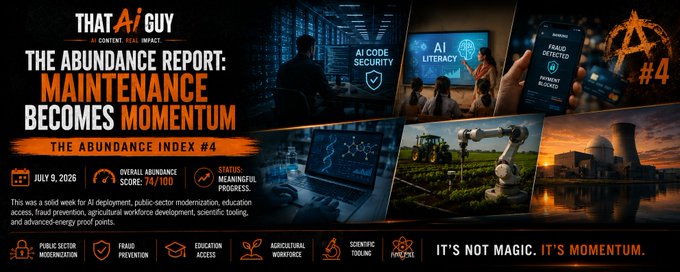
Date: July 9, 2026
Overall Abundance Score: 74/100
Status: Meaningful progress. This was a solid week for AI deployment, public-sector modernization, education access, fraud prevention, agricultural workforce development, scientific tooling, and advanced-energy proof points.
This was not a week of finished miracles.
It was a week of infrastructure getting smarter.
The biggest theme was not “AI will change everything.” That line is tired anyway.
The real story was narrower and more useful:
AI is starting to show up inside the maintenance layer of civilization.
Public codebases are being scanned for security flaws. Banks are pushing fraud detection closer to real time. Scientists are getting better research workbenches. Students are getting AI literacy earlier. Farmers are getting a workforce pipeline for robotics and sensor-driven agriculture. Advanced nuclear developers crossed real technical milestones, even if commercial deployment remains far away.
That is not the cinematic version of progress.
It is the version that tends to matter.
Fewer breaches. Faster services. Better-trained students. Safer payments. More resilient food systems. More credible energy options.
This week’s abundance was mostly enabling progress, not finished abundance. But enabling progress counts. The future does not arrive all at once. It usually shows up first as better tools inside boring systems.
And boring systems run the world.
What Actually Got Better This Week?
This week’s most important pattern was institutional learning.
Governments, schools, banks, labs, farms, and energy developers are all trying to answer the same practical question:
How do we use new tools to make old systems work better?
That is a very different question from “How do we build a flashy AI demo?”
The Alberta code-security story is a good example. Reviewing hundreds of millions of lines of public-sector code is not the kind of thing that usually gets public attention. But old government software touches taxes, permits, healthcare records, licensing systems, benefits, public safety, and critical operations.
If AI can help governments find vulnerabilities faster, patch legacy systems sooner, and reduce the maintenance drag of old code, that is not just a productivity story.
It is a public trust story.
The same pattern showed up in education. Punjab’s statewide AI curriculum rollout is not a guaranteed learning revolution. Curriculum quality, teacher training, devices, language support, and assessment all matter. But broad AI literacy in public schools is the right kind of access story: not just elite students learning frontier tools, but government-school students getting a path into the new economy.
Agriculture had a smaller but important version of the same idea. UTSA and Southwest Research Institute launched a 24-week training program in AI, robotics, and IoT for agriculture. The scale is modest, targeting 40 students over five years, but the need is real. Food systems face labor constraints, climate pressure, and rising productivity demands. Training people who can connect field realities with smart tools is practical abundance.
Finance moved in the same direction. HDFC Bank says it has built its own AI platform and fraud-monitoring system to detect suspicious patterns, including mule-account behavior. The evidence is company-reported and lacks published fraud-reduction metrics, so we should stay cautious. But if large banks can block suspicious credits faster, ordinary people benefit through fewer scams, fewer stolen funds, and more resilient digital payments.
Energy gave us the week’s strongest “real milestone, long road” story. Three advanced nuclear startups reportedly reached criticality around the July 4 deadline in a DOE-backed pilot. Criticality is a real technical milestone. It is not a commercial grid solution. Licensing, fuel supply, safety validation, manufacturing, public trust, and cost remain unresolved. Still, in a world where AI, data centers, manufacturing, desalination, and electrification all need reliable power, advanced nuclear hardware progress is worth tracking.
The week also included a quieter scientific infrastructure story: Claude Science, a beta research workbench from Anthropic with scientific skills, connectors, artifact trails, and examples in genomics, CRISPR screen design, cheminformatics, and molecular epidemiology. If these tools make research more reproducible and reduce analysis time, they could become part of the lab operating system. But this is still beta, still vendor-reported, and still needs independent validation.
The through-line is clear:
Progress this week was not about replacing institutions. It was about institutions learning to move faster.
1. Alberta Used AI Agents to Review a Government Codebase at Massive Scale
The Government of Alberta reportedly used Claude Code to scan 466 million lines of code in 20 hours across provincial systems.
According to the vendor case study, about 50 agents reviewed repositories, flagged exact files and lines, helped generate fixes, and supported continuous review against roughly 95 security controls.
That is a serious scale claim.
Why it matters
Government software is usually invisible until it breaks. When public systems are slow, insecure, or outdated, people experience that as bureaucracy, outages, breaches, delayed services, and expensive maintenance.
AI-assisted code review could help public agencies modernize faster without waiting for impossible staffing levels.
Evidence
The reported numbers are concrete: 466 million lines, 20 hours, roughly 50 agents, and about 95 controls. The caveat is equally important: this is vendor-reported and would benefit from independent audit.
Implications
The immediate benefit is faster vulnerability discovery and more targeted remediation. Even if humans still review and approve fixes, AI can help reduce the size of the search problem.
If this pattern holds, AI may become a normal maintenance layer for public software: reviewing code, finding security drift, documenting legacy systems, and helping governments move from reactive repair to continuous modernization.
Why ordinary people should care
Better-maintained public software means fewer outages, fewer breaches, faster digital services, and less money lost to technical debt.
Source: Anthropic, July 6, 2026. Vendor case study referenced in source brief.
2. Advanced Nuclear Startups Reached Criticality, but the Hard Part Comes Next
Three advanced nuclear startups reportedly reached reactor criticality around the July 4 deadline in a DOE-backed pilot.
Criticality means a reactor has achieved a self-sustaining nuclear chain reaction. That is a real technical milestone.
It is not the same thing as cheap commercial nuclear power.
Why it matters
Abundance needs energy. AI, data centers, factories, desalination, carbon removal, electrified transport, and resilient grids all require reliable power. Solar, wind, batteries, geothermal, transmission, demand response, and nuclear all have roles to play. Advanced nuclear matters because it could eventually provide dense, firm, low-carbon power in places where intermittent supply is not enough.
Evidence
WIRED reported that three nuclear startups backed by a U.S. Department of Energy pilot program hit criticality. The report also emphasized the limits: these are test reactors, not commercial grid assets.
Implications
The next tests are licensing, safety validation, fuel supply, engineering repeatability, cost, and whether these designs can move beyond pilot settings.
If advanced reactors become manufacturable, licenseable, and economically credible, they could support data centers, remote industry, military sites, industrial heat, and communities that need firm power.
Why ordinary people should care
More reliable clean-energy options can eventually mean lower energy risk, fewer grid constraints, and more room for energy-intensive technologies that improve daily life.
Source: WIRED, July 2026. https://www.wired.com/story/nuclear-startups-hit-milestone-why-it-matters
3. Punjab Is Rolling AI Curriculum Into Government Schools
Punjab announced a statewide AI curriculum rollout across all government schools beginning next month, after roughly a year of curriculum development.
That matters because AI literacy should not be reserved for wealthy schools, elite colleges, or self-directed students with good internet access.
Why it matters
If AI becomes a basic work tool, public education has to treat it like a literacy issue. Students need to understand not just how to use AI tools, but how to question them, verify outputs, protect privacy, and use them for learning instead of shortcutting thinking.
Evidence
The Times of India reported the statewide rollout on July 3, including the government’s stated goal of making students future-ready by integrating AI into classroom education.
Implications
The rollout will depend on teacher training, device access, lesson quality, language support, and whether schools can assess actual learning rather than tool exposure.
If done well, public-school AI literacy can broaden access to future work, reduce skill gaps, and help students become informed users instead of passive consumers of technology.
Why ordinary people should care
Education access is one of the highest-leverage forms of abundance. A student who learns to use AI well gains a multiplier for writing, research, coding, design, analysis, and entrepreneurship.
Source: Times of India, July 3, 2026. https://timesofindia.indiatimes.com/education/news/punjab-announces-statewide-ai-curriculum-for-government-schools-rollout-begins-next-month/articleshow/132154922.cms
4. UTSA and Southwest Research Institute Launched AI and Robotics Training for Smart Agriculture
The University of Texas at San Antonio and Southwest Research Institute launched a 24-week program to train undergraduates in AI, robotics, and IoT for agriculture.
The program is backed by a $750,000 USDA grant and will train a small cohort over several years.
This is not a massive deployment yet.
It is workforce infrastructure.
Why it matters
Agriculture is under pressure from labor shortages, climate volatility, water constraints, and rising food demand. Smarter agriculture needs people who understand both technology and field reality.
Evidence
The San Antonio Express-News reported that the program will train students through hands-on lab work and real-world engagement with farmers and extension agents. The source brief notes a target of 40 students over five years.
Implications
The immediate scale is local. The value is in proving a model for training students who can deploy AI, robotics, sensors, and automation in practical agricultural settings.
If replicated, programs like this can build the workforce needed for precision agriculture, safer farm labor, better water use, crop monitoring, and more resilient food production.
Why ordinary people should care
Food abundance depends on farmers having better tools and trained people who can actually use them. Better agricultural productivity eventually shows up as more stable supply, less waste, and greater resilience.
Source: San Antonio Express-News, July 5, 2026. https://www.expressnews.com/business/article/texas-utsa-swri-tech-agriculture-program-22309757.php
5. HDFC Bank Built In-House AI Fraud Monitoring
HDFC Bank says it has built its own AI platform, Neev, along with fraud-monitoring systems intended to identify suspicious behavior faster, including mule-account patterns.
This is another “worth watching” story rather than a fully proven outcome.
Why it matters
Digital finance is abundance when it works: instant payments, easier commerce, lower transaction friction, broader access, and less dependence on physical infrastructure.
But fraud can turn that abundance into fear.
If AI can help banks detect suspicious credits, mule accounts, account takeover patterns, and unusual transaction behavior faster, that protects ordinary users.
Evidence
The Economic Times reported on July 3 that HDFC Bank developed its own AI platform and fraud-monitoring system. The report is based on bank statements and does not yet include published fraud-reduction metrics.
Implications
The important question is whether the system measurably reduces losses, false positives, customer friction, and response time.
AI fraud monitoring could become a basic safety layer for digital finance, especially in countries with massive real-time payment volumes.
Why ordinary people should care
Fraud prevention is not glamorous, but it is deeply practical. Better detection can mean fewer drained accounts, faster intervention, and more trust in digital payments.
Source: Economic Times, July 3, 2026. https://m.economictimes.com/industry/banking/finance/banking/hdfc-bank-develops-own-ai-platform-fraud-monitoring-system/articleshow/132146054.cms
6. Claude Science Points Toward AI as a Research Workbench
Anthropic reportedly released Claude Science in beta, with more than 60 scientific skills and connectors, auditable artifacts, reproducible code trails, and examples in genomics, CRISPR screen design, cheminformatics, and molecular epidemiology.
The strongest reported claim is that one UCSF glioma lab saw analysis time fall to roughly one-tenth of the previous workflow, with independent validation.
That is worth attention, but it needs caution.
Why it matters
Scientific discovery is often slowed by messy workflows: data cleaning, literature review, code generation, documentation, figure preparation, protocol translation, and repetitive analysis. If AI tools make those workflows faster and more reproducible, they can raise scientific throughput without replacing scientific judgment.
Evidence
The source brief attributes the release and examples to Anthropic on June 30, 2026. I was not able to locate a public source URL during this pass, so this should be treated as vendor-reported until independently verified.
Implications
The best near-term use is as a lab workbench: help scientists manage analysis, generate code, document assumptions, and preserve artifact trails that other humans can inspect.
If tools like this become reliable, scientific labs may move from disconnected notebooks, scripts, and files toward more auditable AI-assisted research environments.
Why ordinary people should care
Faster, more reproducible science can eventually mean better diagnostics, cleaner drug discovery, more efficient clinical research, and fewer dead ends.
Source: Anthropic, June 30, 2026. Vendor-reported source referenced in source brief.
The Bigger Picture: AI Is Moving Into the Maintenance Layer
The stories this week are connected by a boring but powerful theme:
Maintenance is becoming smarter.
Alberta’s code-security work is maintenance for public software.
HDFC’s fraud monitoring is maintenance for trust in digital finance.
Claude Science is maintenance for research workflows.
Punjab’s curriculum rollout is maintenance for the education pipeline.
The UTSA/SwRI program is maintenance for the agricultural workforce.
Advanced nuclear criticality is maintenance for the future energy option set.
That is where a lot of real abundance will come from.
Not from a single breakthrough that makes every problem disappear.
From thousands of systems becoming easier to inspect, repair, train, secure, and scale.
The useful phase of AI may look less like a robot replacing everyone and more like competent assistants embedded inside slow institutions.
That is less dramatic.
It is also more believable.
The Contrarian View: Translation Is Still the Bottleneck
The optimistic case is real.
So are the bottlenecks.
AI can identify a promising antibiotic candidate, but it cannot skip toxicology, manufacturing, clinical trials, regulatory review, or antibiotic stewardship.
Battery regeneration can work in controlled research settings, but commercial recycling streams are messy. Real packs differ by chemistry, age, damage history, and manufacturer.
Satellite servicing is exciting, but rendezvous with an unprepared spacecraft is hard. A failed capture attempt can damage the asset it is trying to save.
Direct air capture still faces difficult economics. Energy, water, sorbent lifetime, compression, storage, and cost all matter.
Advanced nuclear has to prove safety, licensing, fuel supply, construction repeatability, and economics before it changes the grid.
AI access is another hard constraint. A new UN analysis warned that AI benefits can concentrate in countries and companies with compute, data infrastructure, energy, language coverage, and technical expertise.
That is the sober read:
Discovery is accelerating, but translation still decides who benefits.
The good news is that this week’s advances were unusually focused on translation. Less fantasy, more process. Less prediction, more plumbing.
That is exactly where durable progress is made.
Everyday Abundance
Here are the practical improvements hiding inside the week’s headlines:
Safer public systems. AI-assisted code review could help governments find vulnerabilities faster and modernize old systems before they fail.
Better digital services. Cleaner government code can mean fewer outages, faster updates, and less money lost maintaining fragile legacy software.
Earlier AI literacy. Punjab’s school rollout could give public-school students a stronger start in the tools that will shape future work.
More resilient food systems. Agriculture students trained in AI, robotics, and IoT can help farms use water, labor, sensors, and machines more effectively.
Safer banking. Real-time AI fraud monitoring could help block suspicious transactions before ordinary people lose money.
More credible clean-energy options. Advanced nuclear criticality does not solve energy, but it expands the set of possible firm, low-carbon power tools.
Faster science. Research workbenches that preserve code trails and artifacts could make scientific analysis faster and easier to check.
What Got Better This Week?
Public systems got a little more maintainable.
Students gained earlier access to AI literacy.
Farmers got another workforce pipeline for smart agriculture.
Banks pushed fraud detection closer to real time.
Scientists got better tools for reproducible analysis.
Advanced nuclear developers crossed a real technical milestone.
The honest version is that most of this is not finished abundance yet.
It is the scaffolding.
But scaffolding matters.
The best stories this week were not vague promises that AI will transform everything. They were narrower, measurable steps:
466 million lines of government code reportedly reviewed.
A statewide AI curriculum prepared for public-school rollout.
A USDA-backed training program launched for smart agriculture.
A major bank building fraud detection closer to the transaction layer.
Scientific workbench tools aimed at reproducibility and speed.
Test reactors reaching criticality.
That is the kind of progress worth tracking.
Not hype.
Not magic.
Just real systems becoming a little easier to secure, teach, operate, and improve.
That is abundance in the form it most often arrives:
Less friction.
Sources
Government of Alberta code-security case study. Anthropic, July 6, 2026.
Advanced nuclear startups reaching criticality. WIRED, July 2026. https://www.wired.com/story/nuclear-startups-hit-milestone-why-it-matters
Punjab statewide AI curriculum rollout. Times of India, July 3, 2026. https://timesofindia.indiatimes.com/education/news/punjab-announces-statewide-ai-curriculum-for-government-schools-rollout-begins-next-month/articleshow/132154922.cms
AI and robotics training for smart agriculture. San Antonio Express-News, July 5, 2026. https://www.expressnews.com/business/article/texas-utsa-swri-tech-agriculture-program-22309757.php
HDFC Bank AI fraud-monitoring platform. Economic Times, July 3, 2026. https://m.economictimes.com/industry/banking/finance/banking/hdfc-bank-develops-own-ai-platform-fraud-monitoring-system/articleshow/132146054.cms
Claude Science beta research workbench. Anthropic, June 30, 2026.