July 23, 2026
Overall Abundance Score: 78/100
There is a quiet kind of progress that does not always look like a moon landing.
No single rocket. No one photograph. No clean “before and after.”
Instead, it shows up as friction disappearing from the systems that make civilization work: discovering a drug, testing a therapy, finding a new antibiotic, deploying clean power, preserving scientific knowledge, getting useful AI into more hands.
That is the thread running through this week’s Abundance Index.
The big story is not simply that AI is getting smarter. It is that digital intelligence is starting to push into the physical world. Biology. Energy. Robotics. Scientific infrastructure. The places where progress has traditionally been slow, expensive, regulated, messy, and very human.
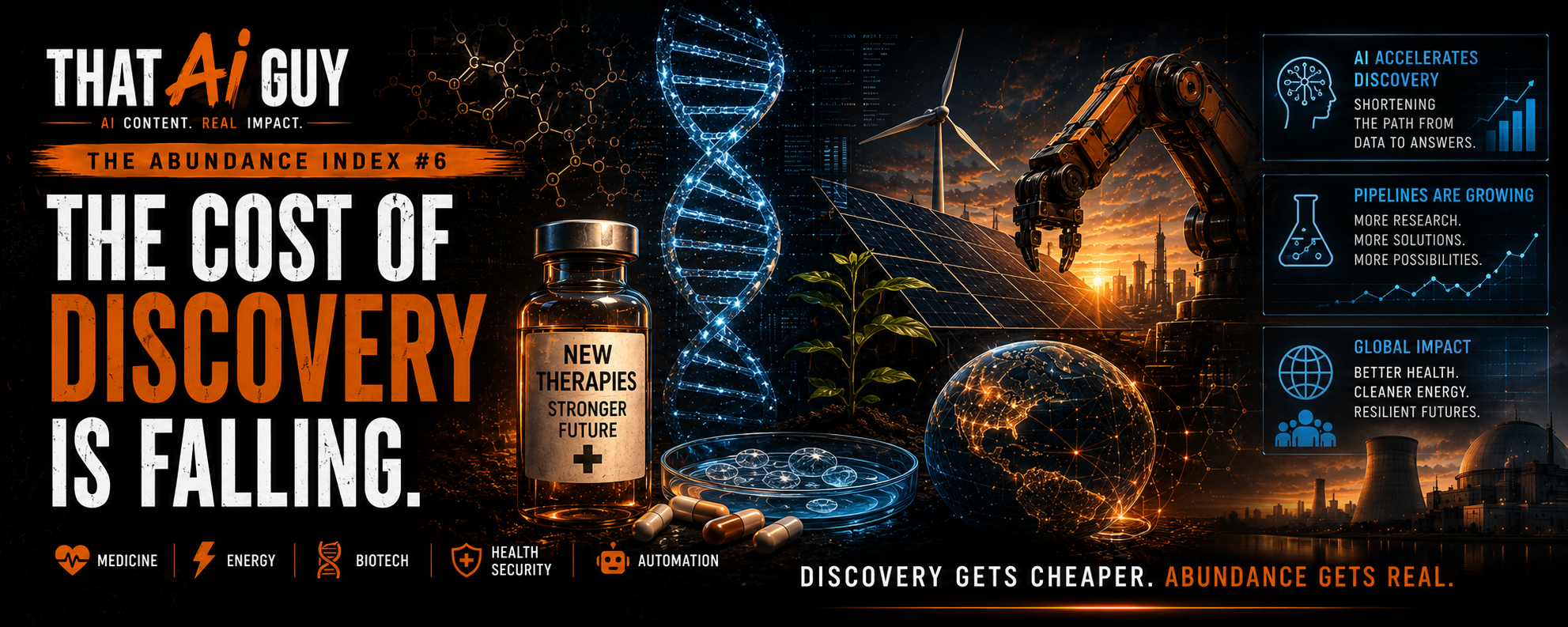
The cost of discovery is beginning to fall.
And when discovery gets cheaper, abundance gets more realistic.
1. AI Is Starting To Compress Drug Discovery
For decades, drug discovery has been brutal.
You start with a biological hunch, screen huge numbers of compounds, spend years narrowing candidates, and then watch most of them fail before they ever reach patients. The system has produced miracles, but it has also been slow, expensive, and wasteful.
AI is not magically fixing that overnight. But it is beginning to change the curve.
A recent review in npj Digital Medicine argues that multimodal AI is becoming a serious tool in biotechnology: systems that can combine genomic data, clinical records, medical imaging, molecular structures, and lab results into more useful predictions.
That matters because biology is not one kind of data. It is many kinds of data stacked on top of each other.
The review points to several early signals: AI-assisted vaccine development, better target discovery, clinical-trial simulation, and AI-designed molecules. It also cites a projection that the AI-in-biotech market could grow from $1.8 billion in 2023 to $13.1 billion by 2034.
The most striking example: researchers used AlphaFold-linked AI workflows to identify a potential liver cancer hit molecule in roughly 30 days.
That does not mean “AI cured liver cancer in a month.” It means something more precise, and still remarkable: AI helped researchers move from target selection to an experimentally tested early hit molecule dramatically faster than traditional discovery workflows usually allow.
The abundance angle is simple:
If the cost of asking biological questions drops, we get to ask more questions.
More shots on goal. More neglected diseases investigated. More candidate molecules tested. More room for smaller labs and startups to participate.
That is not a miracle. It is leverage.
Sources: npj Digital Medicine, Chemical Science / PMC
2. Longevity Is Moving From Mice To Humans
Longevity science has lived under a cloud of hype for a long time.
A lot of things make mice live longer. Very few of those things become meaningful human medicine.
So the useful question is not “Did someone reverse aging this week?” They did not.
The useful question is: are serious longevity-adjacent therapies moving into human trials with measurable endpoints?
Increasingly, yes.
Life Biosciences announced in June that the first participant had been dosed in a Phase 1 trial of ER-100, an epigenetic restoration therapy for optic neuropathies, including open-angle glaucoma and NAION. The trial is focused on safety and tolerability, with visual-function endpoints included.
That is early. Very early.
But it is also important because it moves cellular rejuvenation from the land of animal models and conference slides into regulated human testing.
There are other cautious signals too. A 2024 Nature Medicine Phase 2 trial tested the senolytic combination dasatinib plus quercetin in postmenopausal women. The overall primary endpoint did not improve. That matters, and we should say it plainly.
But exploratory analysis suggested that women with higher senescent-cell burden may have seen better bone-formation markers and improved radius bone mineral density.
So the honest version is this:
Longevity science is not proving human age reversal yet.
But it is starting to learn what can be tested, in whom, and against which biomarkers. That is how hype becomes medicine, if it ever does.
Sources: Life Biosciences, ClinicalTrials.gov, PubMed
3. The Antibiotic Pipeline Is Alive, But Still Not Enough
Abundance is not only about new frontiers. Sometimes it is about defending the foundations we already depend on.
Antibiotics are one of those foundations.
Modern surgery, cancer treatment, childbirth, organ transplants, and routine infection care all depend on antibiotics working. Antimicrobial resistance threatens that entire stack.
A 2025 review in npj Antimicrobials and Resistance lays out both the progress and the problem.
There are 97 antibacterial agents in the current clinical pipeline, including 57 traditional antibiotics and 40 non-traditional antibacterials. Many are aimed at priority pathogens, including hard-to-treat Gram-negative bacteria.
That is good.
But the World Health Organization has also warned that the pipeline remains insufficient. Since 2017, only a small number of newly authorized antibiotics have represented truly new chemical classes. The market is broken: new antibiotics are expensive to develop, but stewardship correctly limits how often they are used, which makes the business model unattractive.
The UN has pledged to reduce AMR-associated deaths by 10% by 2030 and called for $100 million in catalytic funding to help countries execute national AMR plans.
That number is not enough by itself. But it is a signal that the world is at least naming the problem.
The abundance framing here is defensive abundance:
A richer future requires preserving the basic tools that keep ordinary infections from becoming existential threats.
Sources: npj Antimicrobials and Resistance, WHO
4. Nuclear Policy Is Trying To Catch Up With Energy Demand
AI uses electricity. Industry uses electricity. Data centers use electricity. Electrified transportation, manufacturing, desalination, and robotics will all use more electricity.
If we want abundance, we need clean firm power.
That is why nuclear keeps coming back into the conversation.
In April, Senators Mike Lee and Dave McCormick introduced the Nuclear Energy Innovation and Deployment Act of 2026. The bill has not become law. It was introduced and referred to the Senate Energy and Natural Resources Committee.
So this is not a victory lap. It is a policy signal.
The bill would create a “Nuclear Energy Launch Pad” for testing and demonstrating advanced nuclear technologies, clarify DOE authority, support deployment through power purchase and transmission tools, and explore repurposing surplus plutonium for advanced reactors.
The bottleneck for nuclear has rarely been whether splitting atoms works.
The bottleneck is whether we can build, license, finance, and deploy safely at anything close to the speed our energy needs require.
If advanced nuclear can move from prototype to repeatable deployment, it becomes part of the abundance stack: clean baseload power for AI, manufacturing, robotics, homes, and industry.
That is still an “if.”
But it is an “if” worth tracking.
Sources: Senate Energy Committee, GovInfo S.4284
5. Open Models Are Getting Easier To Deploy
The AI abundance story is not just about the biggest frontier models.
It is also about who can use good-enough models, where they can run, and how much infrastructure pain stands between an idea and a working tool.
Microsoft Foundry Managed Compute and Hugging Face’s integration with it are a useful signal here. Developers can deploy open-source models from the Hugging Face ecosystem onto managed GPU infrastructure without operating their own Kubernetes clusters, patching containers, or manually provisioning machines.
That sounds technical because it is.
But the human version is this:
More people can run useful AI systems without needing to become infrastructure specialists first.
That matters for small teams, internal tools, nonprofits, local businesses, and weird little experiments that never would have survived a full enterprise buildout.
The next wave of AI adoption may not come from a single giant model announcement. It may come from thousands of smaller deployments becoming easier to stand up, govern, monitor, and afford.
Sources: Hugging Face, Microsoft Learn
6. Science Is Learning To Waste Less Knowledge
One of the most underrated sources of scarcity is repeated failure.
Not failure itself. Failure is necessary.
The waste comes when failure is not recorded well enough for anyone else to learn from it.
A 2026 Nature Communications Perspective argues that modern science needs better systems for preserving knowledge, especially in large-scale, automated, AI-assisted research environments. The authors point to FAIR principles: making data findable, accessible, interoperable, and reusable.
This sounds dry.
It is not.
If a lab spends six months discovering that a method does not work, and that knowledge disappears into someone’s notebook or an unpublished folder, the next lab may spend another six months making the same mistake.
Multiply that across biology, materials science, climate tech, robotics, and medicine, and you get an invisible tax on progress.
AI may help here, not by replacing scientists, but by documenting experiments, capturing context, preserving null results, and making old knowledge easier to retrieve.
Abundance is not only about inventing more.
It is also about forgetting less.
Source: Nature Communications
The Pattern: Discovery Is Becoming More Searchable
Across these stories, the pattern is bigger than any one field.
AI helps search biological space.
Managed compute helps search model space.
Better documentation helps search scientific memory.
Nuclear reform tries to clear the path from prototype to deployment.
Antibiotic work tries to preserve the medical ground we already stand on.
Longevity trials are beginning to test whether the biology of aging can be moved from theory into evidence.
This is what abundance actually looks like most weeks.
Not utopia. Not instant transformation. Not “everything is solved.”
More like this:
A bottleneck gets named.
A tool gets cheaper.
A trial begins.
A policy path opens.
A failed experiment becomes reusable knowledge.
A system that used to move slowly starts to move a little faster.
The Abundance Index For This Week: 78
This week’s score is 78: Accelerating Progress.
The strongest signal is AI’s growing ability to reduce the cost and time of discovery, especially in biotech and scientific workflows.
The caution is that many of these developments are early. A hit molecule is not a medicine. A Phase 1 trial is not proof of rejuvenation. A bill introduction is not deployed nuclear power. A market forecast is not real-world adoption.
But the direction is clear enough to matter.
We are watching intelligence move from screens into systems.
And if we can keep our standards high while letting ourselves notice the progress, the conclusion is a hopeful one:
Humanity is getting better at finding the next useful thing.