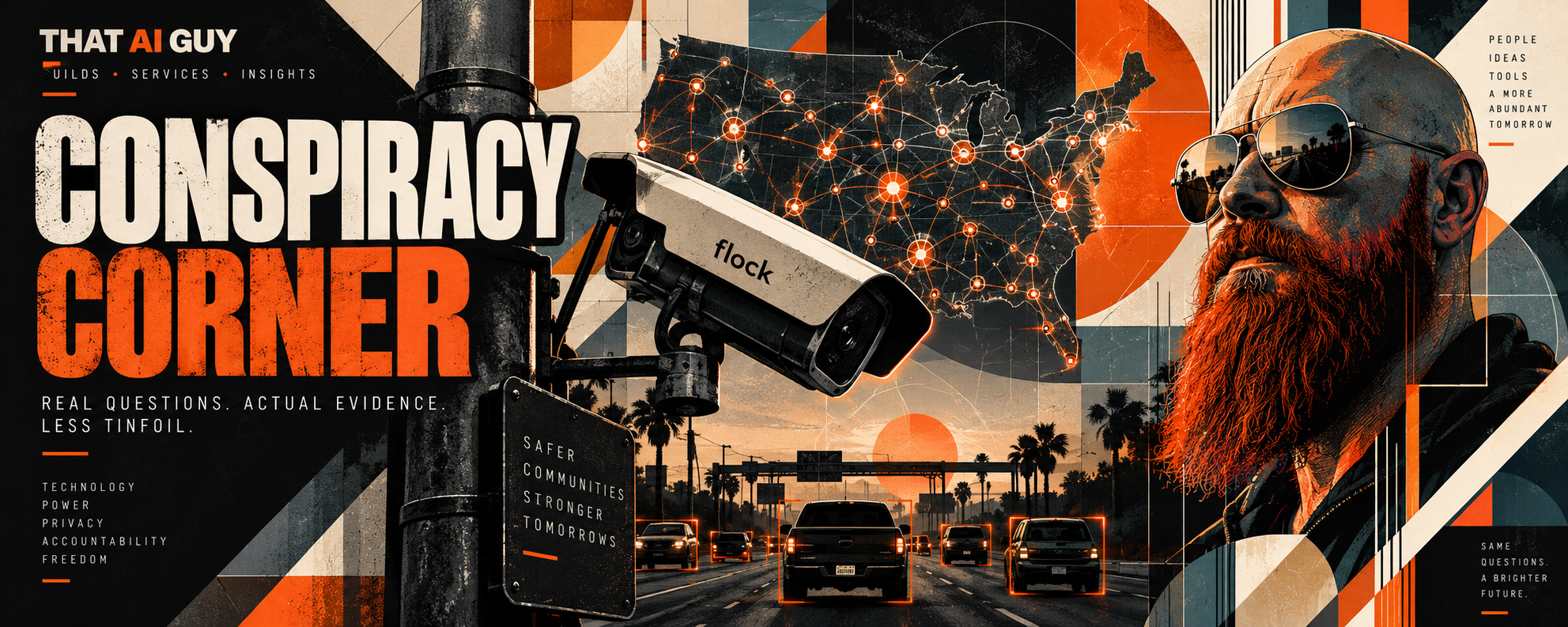
There are roughly 120,000 Flock Safety cameras scattered across 49 states.
They sit beside roads, at intersections, outside neighborhoods and businesses. They photograph passing vehicles, read license plates, record when and where those vehicles were seen, and make that information searchable.
Police departments use them to find stolen cars. They use them to locate missing people. They use them to investigate crimes.
And, occasionally, police officers have used them to stalk their wives and girlfriends.
So...welcome to Conspiracy Corner.
This is a new occasional feature where I’m going to take something that sounds vaguely insane when somebody posts it on the internet and try to figure out how much of it is actually true.
No predetermined conclusion. No requirement that a conspiracy actually be found. No automatic assumption that government is evil, corporations are evil, or the guy posting from his truck wearing Oakleys has uncovered the New World Order.
Just receipts.
And we’re starting with Flock. Because this one gets weird.
First: What the Hell Is Flock?
Flock Safety makes automated license plate readers, usually called ALPRs.
You’ve probably driven past them without noticing.
They aren’t traditional traffic cameras waiting for somebody to run a red light. They continuously photograph passing vehicles and use computer vision to identify things like license plates and vehicle characteristics.
That information becomes searchable.
If somebody steals your truck, police don’t necessarily have to wait until an officer happens to spot it. They can search for the plate. If cameras saw it, investigators may be able to determine where it went.
That’s extraordinarily useful.
And Flock has become extraordinarily large.
The company now operates roughly 120,000 cameras across 49 states. Flock says its cameras generate roughly 20 billion plate observations per month.
Twenty. Billion. Every month.
And Flock isn’t the entire ALPR ecosystem. Independent mapping efforts now document roughly 141,000 automated license plate readers from multiple vendors, with Flock representing about 81% of readers for which a manufacturer has been identified.
So even if every Flock camera vanished tomorrow, the underlying technology wouldn’t.
Flock also says its technology assists with around one million investigations annually and that, in 2025, its system helped locate an average of 27 missing people every day.
Those are company figures, so treat them accordingly. But there’s no serious dispute about the basic point:
This technology works.
Which is important, because the easiest version of this argument is also the dumbest.
“Cameras bad. Surveillance bad. Tear them all down.”
I’m not there.
If somebody kidnaps a child and police can identify the vehicle and reconstruct where it went, I want them using every damn camera available.
If someone steals my truck, please feel free to find it before it’s halfway to Miami.
The problem isn’t that the cameras can find cars.
The problem is that the cameras can find cars.
Including yours. Including mine. Including everybody else’s.
When Does Observation Become Surveillance?
Here’s where things get philosophically interesting.
If I’m driving through Fort Myers and a police officer sees my truck go by, I don’t think the government has violated my privacy. I’m driving on a public road.
If a camera sees my truck instead, I’m still not particularly bothered.
But now put 120,000 cameras around the country.
Save their observations.
Make those observations searchable.
Connect thousands of law enforcement agencies.
Allow data to be shared between agencies.
Suddenly we’ve created something fundamentally different from a cop standing beside the road.
It’s not just observation anymore.
It’s memory.
And memory changes the equation.
The question isn’t:
Can the police see my license plate?
Of course they can.
The question becomes:
How much of my historical movement should the government be able to reconstruct without a warrant?
That’s a much more interesting question.
And apparently America decided to answer it by building the network first and having the debate afterward.
Very on-brand for us.
Then Humans Did What Humans Do
Whenever somebody tells me a powerful technology can’t be abused because there are policies against abusing it, I assume they haven’t met many humans.
Flock is no exception.
A major Washington Post investigation published last month identified at least 69 police officials who had been accused, charged or convicted of misusing Flock or other automated license plate reader systems.
Some allegedly used the technology to track romantic partners, wives, exes or other people in their personal lives.
One Indianapolis officer allegedly searched vehicles connected to his wife and two acquaintances 3,759 times over ten months.
That’s not checking a plate because it looked familiar. That’s a hobby.
The Indianapolis Police Department suspended the officer, launched administrative and criminal investigations, and recommended his termination.
Another Florida officer in Haines City allegedly searched his wife’s vehicle repeatedly for nearly two years, entering supposed investigative justifications despite the vehicle not being connected to those investigations.
He was arrested and charged with two felonies.
Other departments have fired employees after discovering misuse.
So the abuse isn’t theoretical.
It happened.
But there’s another part of that story that’s worth noticing.
They got caught.
And in several of the named cases, they got hammered for it.
That’s not an argument for ignoring the abuse. It’s evidence that accountability is possible.
The bigger problem uncovered by the Post wasn’t merely that rogue officers existed. Of course rogue officers exist.
The disturbing part was that many departments weren’t routinely auditing searches in the first place.
In at least 15 of the 69 cases identified by the Post, the potential misuse was first uncovered by someone outside the department, including journalists, activists or victims.
That’s the part that should make your eyebrow go up.
Having an audit log doesn’t accomplish much if nobody looks at the damn thing.
And Here’s Where Flock Deserves Some Credit
This is where the story stops cooperating with a nice clean dystopian narrative.
Because Flock responded.
And, frankly, most of the changes make sense.
In August, after the Washington Post began publishing its investigation into misuse of ALPR systems, Flock announced a substantial package of new safeguards.
For new law-enforcement customers, the company’s default data-retention period is dropping from 30 days to seven days.
For cases where investigators legitimately need records preserved longer, Flock is introducing an “Evidence Mode” that allows specific records associated with an active investigation to be retained.
That’s a pretty reasonable balance.
Keep everyone’s routine travel data for less time. Preserve specific evidence when there’s an actual reason to preserve it.
More importantly, Flock is moving toward requiring officers to associate searches with case codes.
That matters.
If you’re searching for Aaron’s truck at 11:47 Tuesday night, there should be a reason.
And there should be a record of that reason.
Flock is also making its Audit Assistance system mandatory rather than optional. The system analyzes usage for abnormal patterns that could indicate misuse.
Repeatedly searching one person’s plate? Odd bursts of searches? Patterns that don’t look like normal investigative activity?
Those can be flagged for review.
Flock is also adding proactive account lockouts for suspicious behavior and requiring multi-factor authentication.
And the company is adding more granular controls over what kinds of investigations agencies can share data for.
Instead of treating interagency sharing as one giant on/off switch, agencies can permit sharing for certain categories, such as stolen vehicles or violent crimes, while blocking other uses, including immigration-related searches.
That’s an important distinction.
Not every agency that can help find a kidnapped child necessarily needs access for every conceivable law-enforcement purpose.
There’s also an important timing caveat here.
Some of these protections are being rolled out rather than already operating universally. Flock says requirements including case codes and mandatory Audit Assistance are scheduled to apply across law-enforcement customers by the end of 2026.
So we shouldn’t give Flock credit for a finished job that isn’t finished yet.
But this is the stuff I actually want technology companies doing.
Not pretending misuse is impossible.
Not banning useful technology because misuse is possible.
Engineer around the misuse.
Make abuse difficult.
Make it visible.
Make it attributable.
And when somebody does it anyway, punish them.
That’s a much more scalable answer than pretending humans will suddenly stop being humans.
Seven Days Comes With an Asterisk
There’s another important detail here.
You may see claims that Flock now deletes everyone’s data after seven days.
That’s not quite right.
Seven days is the new default for new law-enforcement customers.
Existing law-enforcement customers can retain previously established retention periods according to their agreements and local policies.
Private-sector customers also maintain the retention arrangements established for their accounts.
Flock says customers own and control their data and that Flock does not sell customer data.
So:
“Flock permanently tracks everyone forever.”
No.
“Every Flock record disappears after seven days.”
Also no.
Reality continues its annoying habit of refusing to fit comfortably on a bumper sticker.
Florida Has Entered the Chat
This story gets particularly interesting here in Florida.
At the end of August, the Florida Department of Transportation revoked permits for license plate readers installed within state highway rights-of-way and stopped issuing new permits.
Governor Ron DeSantis has also criticized the proliferation of the cameras.
Florida isn’t alone.
Texas paused state funding for the technology in August, and communities elsewhere have begun reconsidering contracts.
The public mood is changing too.
A large YouGov survey of roughly 20,000 American adults, shared with The Washington Post, found 46% opposed having Flock cameras in their communities while 38% supported them.
That’s particularly notable because public opinion had moved in the opposite direction from polling the previous year.
A separate Reuters/Ipsos poll published September 11 found some pretty dramatic demographic splits. Support remained strongest among older Americans and Republicans, while only 21% of adults ages 18–34 supported the cameras.
In other words, Americans aren’t simply sorting themselves into the usual political camps over this one.
That creates an interesting situation where I find myself somewhere between Flock and its critics.
I understand the backlash.
I’m not convinced ripping cameras out of the ground is the best response.
If the problem is unauthorized searches, then solve unauthorized searches.
If the problem is excessive retention, reduce retention.
If the problem is uncontrolled data sharing, restrict sharing.
If the problem is officers accessing the system for personal reasons, require case numbers, audit searches and fire people who abuse it.
Those seem considerably more proportional than:
CAMERA BAD. REMOVE CAMERA.
Technology doesn’t have to choose between usefulness and civil liberties if we actually bother engineering civil liberties into the system.
What About ICE and the Feds?
This is where the internet version of the story tends to grow tentacles.
One of the recurring claims is that Flock essentially provides federal agencies, particularly immigration enforcement, with a giant national tracking database.
The reality is more complicated.
Flock says ICE does not have direct access to its network, that federal sharing is disabled by default, and that federal agencies aren’t automatically plugged into some giant nationwide lookup system.
Flock has previously worked with federal agencies through pilot programs, including the FBI, ATF, NCIS, Homeland Security Investigations and Customs and Border Protection.
Those pilots ended.
That doesn’t mean federal authorities can never obtain information originating from Flock.
Local agencies can share information under certain circumstances, legal process can compel records, and interconnected systems inevitably create pathways through which information can move.
That’s precisely why those new sharing controls matter.
So:
“ICE secretly has a live feed of every Flock camera in America.”
I can’t find evidence for that.
“Vehicle-location information collected by local systems can never reach federal authorities.”
That’s not true either.
Once again, reality has planted its flag directly in the annoying middle.
The Constitutional Question Isn’t Settled Either
There’s also a fascinating legal question underneath all of this.
Does searching a large historical database of vehicle movements constitute a search under the Fourth Amendment?
At least one federal court has recently said no.
In January 2026, a federal district court ruled in Schmidt v. City of Norfolk that Norfolk’s use of automated license plate readers did not violate the Fourth Amendment.
The challengers, backed by civil-liberties groups including the ACLU and Electronic Frontier Foundation, argue that the scale of modern ALPR networks changes the constitutional analysis.
Their basic argument makes intuitive sense even if the courts ultimately reject it.
Seeing somebody drive down a public street isn’t the same capability as typing their license plate into a database and reconstructing portions of their movements across time and geography.
The case is being appealed.
And I suspect we’re going to see much more litigation around this question.
Because the underlying technological capability is growing much faster than Fourth Amendment precedent was designed to contemplate.
The Actual Conspiracy
So let’s return to the scary version.
Did Flock secretly construct a nationwide government surveillance system designed to track Americans everywhere they go?
I can’t find evidence for that.
Flock didn’t secretly become the Ministry of Transportation Stalking.
What appears to have happened is both less sinister and, in some ways, more fascinating.
Thousands of individual organizations made individually rational decisions.
- A police department wanted to catch stolen cars.
- Another wanted to find suspects.
- A neighborhood wanted better security.
- A business wanted to identify vehicles connected to theft.
- Another town bought cameras.
- Then another.
- Then another.
Sharing made each camera more useful.
Networks became networks of networks.
And somewhere along the way, all those individually useful nodes became something that begins to resemble a national vehicle-location infrastructure.
Nobody needed to sit in a dark room and design the surveillance state.
We assembled it one useful camera at a time.
That’s the part worth thinking about.
Because Flock won’t be the last time this happens.
- AI agents will do it.
- Facial recognition will do it.
- Drones will do it.
- Genetic databases have arguably already done it.
- Data brokers definitely did it.
Each individual capability can be useful.
Each individual decision can be reasonable.
Then suddenly you zoom out and realize the combined system possesses a capability nobody explicitly decided the combined system should possess.
That’s where governance gets hard.
So...Should We Be Worried?
A little.
Not because Flock is obviously evil. I haven’t found evidence that it is.
Not because license plate readers have no legitimate purpose. They clearly do.
And not because the safeguards are meaningless.
In fact, I think Flock’s recent changes are mostly the right response.
Seven-day default retention for new law-enforcement customers is better than 30.
Case codes are better than “trust me, bro.”
Mandatory automated auditing is better than hoping a police chief occasionally clicks through a dashboard.
Granular controls over what kinds of investigations can access shared data are better than indiscriminate sharing.
MFA is obvious.
Locking suspicious accounts is sensible.
And aggressively disciplining people caught abusing access is exactly what should happen.
The important thing now is making sure those promised safeguards actually become universal practice rather than good bullet points in an August press release.
But the episode exposes a larger principle that matters far beyond Flock:
The more powerful the technology, the more important accountability becomes.
My instinct isn’t to stop technological progress because somebody might misuse it.
Quite the opposite.
Build the technology.
Use the technology.
Take the enormous benefits.
But build the guardrails alongside it.
Give people access when they have legitimate reasons.
Record what they do.
Minimize unnecessary data.
Make abuse detectable.
Make consequences painful.
And keep revisiting the rules as the technology evolves.
Liberty doesn’t require technological stagnation.
It requires making sure powerful systems remain accountable to the people using them and the people subjected to them.
Sources & Further Reading
- Flock Safety: August 2026 privacy, accountability and security reforms, including the seven-day recommended/default retention period for new law-enforcement customers, Evidence Mode, offense-type sharing filters, mandatory case codes, Audit Assistance, proactive lockouts and MFA.
- The Washington Post: Police departments weren’t looking for officers abusing Flock. We did it for them., the August 19 investigation documenting at least 69 officials accused, charged or convicted of ALPR misuse and serious gaps in departmental auditing.
- Reuters: Florida bans highway license-plate readers as backlash over surveillance spreads, covering Florida’s restrictions, the broader national backlash and Flock’s roughly 120,000-camera footprint.
- YouGov / The Washington Post: Americans have turned against police cameras that track license plates, new survey shows. The August 2026 YouGov survey of roughly 20,000 U.S. adults found 46% opposed ALPR use in their communities and 38% supported it, reversing the previous year’s result.
- Reuters/Ipsos: Who likes Flock AI cameras? Reuters/Ipsos polled 1,000 Americans to find out. The September 11 survey examines the demographic and political divide over Flock, including particularly low support among adults ages 18–34.
- Federal court: Schmidt v. City of Norfolk, January 2026 opinion and order. The district court granted summary judgment to Norfolk and rejected the plaintiffs’ Fourth Amendment challenge to the city’s ALPR program. The case is now on appeal.
- ACLU / Electronic Frontier Foundation: Amicus brief in the Schmidt appeal, arguing that large-scale, interconnected ALPR surveillance raises Fourth Amendment concerns fundamentally different from an officer simply observing a vehicle on a public road.
- Flock Safety: Flock’s explanation of ICE and federal access, including its position that federal sharing is disabled by default and ICE has no direct access unless a controlling agency deliberately permits access.
- Flock Safety: How Flock handles license-plate data retention and deletion, including customer control of retention periods, automated deletion and audit controls.
- Flock Safety: What the 2026 privacy changes mean for private-sector customers, clarifying that the new seven-day default applies to new law-enforcement customers, while private-sector customers retain the terms established for their accounts.