Research context & caveats
This article is educational and exploratory. It is not medical advice, diagnosis, therapy, or crisis support. If you or someone nearby may be in immediate danger or thinking about self-harm, contact emergency services or call/text 988 in the United States and Canada.
Executive Summary
Avoidant Personality Disorder, often shortened to AvPD, is a persistent pattern of social inhibition, feelings of inadequacy, and hypersensitivity to criticism or rejection. But a symptom list can miss the lived reality. The avoidant person may not dislike people. They may want friendship, love, recognition, and belonging intensely. The problem is that connection feels like a courtroom. Every interaction can feel like a trial where the verdict is personal worth.
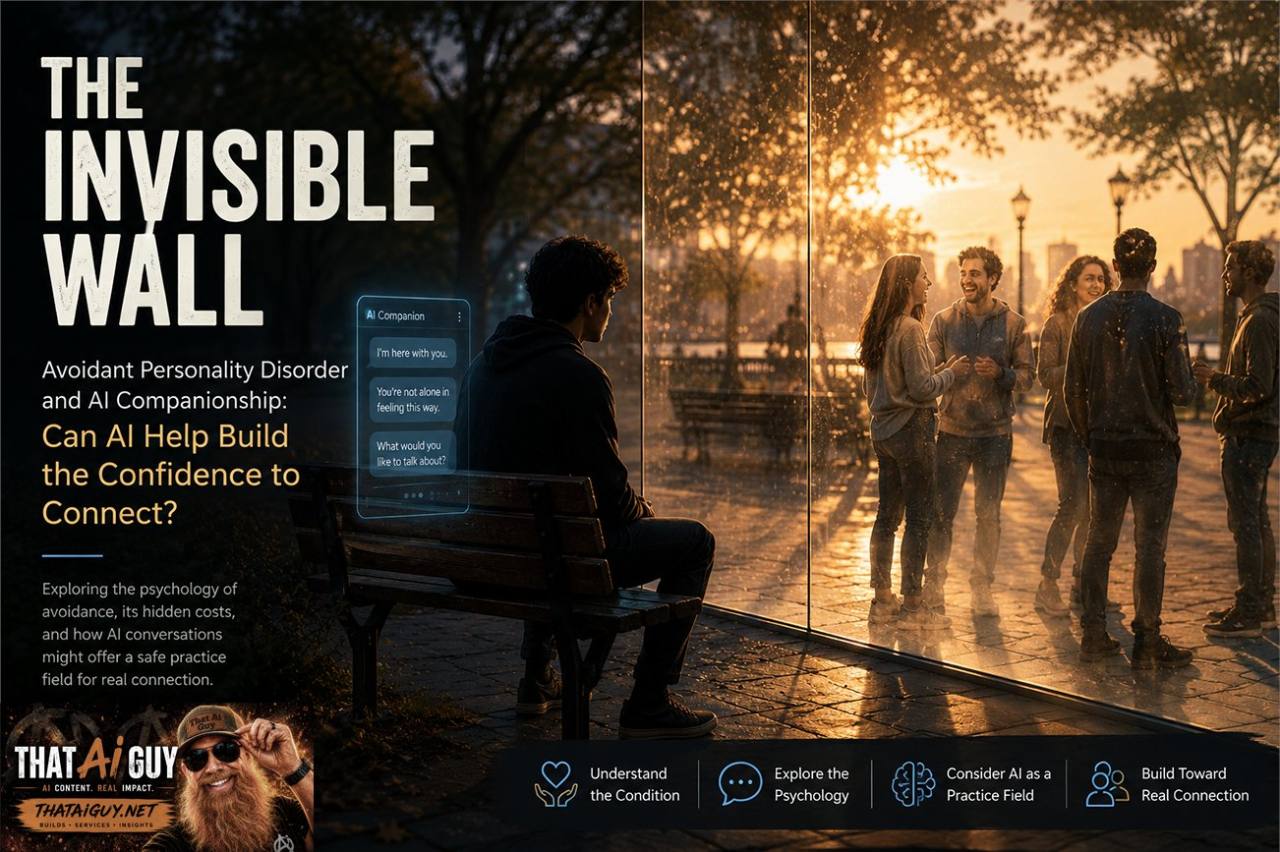
That is the invisible wall. From the outside, avoidance can look like aloofness, laziness, arrogance, disinterest, or simple introversion. From the inside, it often feels like self-preservation. The nervous system learns that visibility is dangerous, intimacy is risky, and embarrassment is not a passing discomfort but a catastrophe. Over time, the behaviors that once reduced pain begin to produce the deeper pain of isolation.
This brief synthesizes two local reports on AvPD in young people and young adults, then extends them into a larger question: can conversational AI help some avoidant people practice connection in a lower-pressure environment? The answer is cautiously yes, if the AI is designed and used as a bridge. The answer becomes no, or at least dangerous, if the AI becomes a substitute for human relationships, professional care, or reality-testing.
The most hopeful frame is this: AvPD should not be treated as a permanent identity. It is better understood as a learned protection strategy, often shaped by temperament, criticism, bullying, trauma, neurodivergence, social comparison, and repeated experiences of shame. Learned patterns can be modified. The wall is real, but walls are built one brick at a time. They can be dismantled the same way.
1. What AvPD Is, Beyond Shyness
Clinical descriptions of AvPD generally center on a pervasive pattern that begins by early adulthood: social inhibition, feelings of inadequacy, and hypersensitivity to negative evaluation. Common features include avoiding work or school activities that involve interpersonal contact, reluctance to become involved with others unless acceptance feels guaranteed, restraint in intimate relationships because of fear of shame, preoccupation with criticism, and reluctance to take personal risks that might prove embarrassing.
The key word is pervasive. Many people feel shy at a party, anxious before a presentation, or insecure during a rough season. AvPD is broader. It can shape how a person chooses work, friendships, dating, education, hobbies, and even whether they answer a text. The avoidant mind is not merely asking, "Will this be awkward?" It is asking, "Will this reveal that I am defective?"
This is why AvPD can be so painful in young adulthood. That stage of life demands repeated social risk: leaving home, trying college or work, dating, forming adult friendships, networking, building identity, and learning to tolerate trial and error. For someone whose internal alarm treats rejection as proof of worthlessness, ordinary developmental tasks can feel like emotional survival tests.
AvPD is also not a character flaw. It is not laziness, rudeness, narcissism, or a lack of ambition. It is often the opposite: too much sensitivity, too much self-monitoring, too much imagined consequence. The person may care so much about connection that the possibility of losing it becomes intolerable.
2. What AvPD Is Not
AvPD overlaps with several conditions and traits, but the motivation underneath matters.
Introversion is a preference and energy pattern. An introvert may enjoy solitude and still feel capable of connection when they want it. Avoidance is different: "I want to connect, but I do not believe I can survive the risk."
Social Anxiety Disorder often centers on fear of scrutiny or performance in social situations. AvPD can include that, but it is usually more fused with identity. Social anxiety may say, "I might embarrass myself." AvPD says, "If I embarrass myself, everyone will see what I really am."
Autism Spectrum Disorder involves differences in social communication, sensory processing, routines, and cognition. An autistic person may avoid a party because it is loud, unpredictable, exhausting, or difficult to parse. A person with AvPD may avoid the same party because being judged feels unbearable. These can overlap, and years of misunderstood neurodivergence can feed avoidant patterns, but they are not the same thing.
Complex PTSD can also involve withdrawal, shame, threat sensitivity, and interpersonal fear. The distinction is not always clean. Trauma-informed assessment matters because similar behaviors can come from different histories.
Schizoid Personality Disorder can look similar from the outside because both may involve solitude. The inner experience is often opposite. Schizoid patterns are marked by limited desire for close relationships. AvPD is marked by longing plus fear. One person may be content alone. The other may be lonely behind a locked door they do not know how to open.
3. The Economics of Rejection
One useful way to understand avoidance is to look at emotional weighting. A typical person might see a social opportunity like this: possible embarrassment is unpleasant, but possible friendship is valuable. The risk is real, but it is not infinite.
The avoidant mind often uses a different exchange rate. Potential embarrassment is catastrophic. Potential friendship is uncertain. The downside feels immediate, vivid, and identity-threatening. The upside feels distant, fragile, and unlikely. When the mind prices rejection this way, avoidance becomes the "rational" choice from inside the system.
This is why reassurance often fails. Telling someone "nobody cares that much" may be logically accurate, but the avoidant nervous system is not only solving a logic problem. It is trying to prevent shame. Shame does not say, "That interaction went badly." Shame says, "You are bad, and now they know."
The avoidance loop then reinforces itself. A social invitation appears. Fear spikes. The person declines, delays, ghosts, cancels, or stays quiet. Anxiety drops immediately, which teaches the nervous system that avoidance worked. Later, loneliness arrives. The person interprets the loneliness as evidence that they are unlikable. The next invitation feels even more dangerous.
This is the protection-prison paradox. The same mechanism that prevents short-term pain becomes the engine of long-term suffering.
4. The Intelligence Trap
Intelligent people can become especially skilled at protecting avoidance from challenge. Intelligence can build arguments, not just insights. It can become defense counsel for fear.
The rationalizations can sound mature: "I am respecting their space." "I will socialize once I am more confident." "They already have enough friends." "I should fix myself before I date." "I am focusing on work right now." Sometimes those statements are true. But avoidance often hides inside true-sounding sentences.
The trap is that insight can start to feel like progress even when behavior never changes. A person may understand their attachment style, childhood patterns, trauma responses, cognitive distortions, and diagnostic possibilities while still avoiding the tiny real-world risks that would teach the nervous system something new. They are not lazy. They are over-equipped for analysis and under-supported for action.
Recovery usually requires a shift from perfect understanding to tolerable practice. Not reckless exposure. Not "just get out there." Small, repeated experiences of safe-enough visibility. A sent message. A short walk with someone. A low-pressure group. A therapy session attended even while embarrassed. A conversation where the goal is not brilliance but staying present.
5. Social Media, Digital Life, and Post-Pandemic Isolation
Digital communication can be both lifeline and trap. For avoidant people, online spaces offer controlled visibility: edited text, delayed replies, avatars, distance, and the ability to disappear. That can be genuinely helpful. It may allow a person to express parts of themselves that feel too vulnerable face to face.
But the same safety can become too effective. If every interaction is mediated through a screen, the person may get less practice tolerating facial expressions, pauses, ambiguity, ordinary awkwardness, and repair after misunderstanding. Social confidence is partly built by surviving imperfect interactions. Avoidance removes the practice field.
Social media adds another pressure: constant comparison. Curated images of friendship, romance, parties, career success, and effortless belonging can become a distorted mirror. The avoidant viewer may not think, "This is a highlight reel." They may think, "Everyone else knows how to be human except me."
The pandemic years intensified this for many young people. Isolation interrupted normal social learning. For those already prone to avoidance, staying home may have felt like relief and proof at the same time: relief because the threat was gone, proof because returning to ordinary life felt even harder. The world reopened, but the nervous system did not necessarily reopen with it.
6. The AI Bridge Hypothesis
Conversational AI introduces a new possibility. A well-designed AI system can provide low-pressure dialogue, unlimited patience, nonjudgmental reflection, journaling prompts, role-play, cognitive reframing, and rehearsal for difficult conversations. For someone with avoidant tendencies, that can matter.
The strongest version of the idea is not "AI friend replaces human friend." It is "AI practice field helps a person become more capable with human beings." Like training wheels, a flight simulator, or a conversational rehearsal room, AI can let someone practice without the full perceived cost of visible embarrassment.
A person might use AI to prepare a text they are scared to send, rehearse how to ask a classmate to study, practice saying no without over-apologizing, identify catastrophic predictions, or process the post-event autopsy after a social moment. The AI can help separate facts from interpretations: What actually happened? What did you infer? What else might be true? What tiny next step would match your values?
There is also a shame-reduction function. Many avoidant people have never experienced sustained curiosity without immediate evaluation. A patient, reflective system can model a different inner voice. Not a voice that flatters everything, but one that slows down, asks, "What are you protecting yourself from?" and helps the user notice that fear is not the same as truth.
This is where companion design matters. The future of AI companionship should not be maximizing time-on-platform. In mental-health-adjacent contexts, the best system may be one that helps the user need it less over time. The goal is more human agency, not deeper enclosure.
7. The Risks: When the Bridge Becomes the Room
The risk is obvious and serious: AI can become an even more comfortable avoidance zone. If a person feels seen by a system that never gets tired, never rejects them, never has needs, and never creates the messy reciprocity of human friendship, real people may feel even more dangerous by comparison.
Heavy use may also reinforce loneliness, emotional dependence, or compulsive patterns, especially if the system is optimized to keep the conversation going rather than help the user move outward. Recent research on psychosocial chatbot effects has found that outcomes can vary by usage level, modality, attachment tendencies, and conversation type. In plain English: these tools are not psychologically neutral.
There are crisis and safety risks as well. General-purpose AI is not a licensed clinician, cannot reliably understand the full context of a life, and may respond poorly in high-risk mental health situations. Some systems can become too agreeable, validating distorted beliefs instead of gently reality-testing them. For vulnerable users, that can be harmful.
Privacy matters too. Avoidant users may disclose intimate fears, trauma, sexual shame, family conflict, or self-harm thoughts to a chatbot because it feels safer than telling a person. That data deserves serious protection. A companion that invites vulnerability without strong privacy, safety, and escalation design is not a harmless toy.
The design principle should be simple: AI as bridge, not destination. A good system might encourage offline steps, support therapy homework, help users identify trusted humans, suggest breaks, detect crisis language, avoid romantic or dependency-maximizing manipulation, and make clear what it is and is not.
8. Recovery and Evidence-Based Support
AvPD treatment research is smaller than it should be, but several approaches appear relevant. Psychotherapy is the center of care. Medication may help with co-occurring anxiety or depression, but there is no medication that simply cures AvPD.
Schema Therapy targets deep patterns such as defectiveness, social isolation, emotional deprivation, and punitive self-criticism. It can help a person recognize protective modes, including the part that withdraws to prevent humiliation, while building a healthier adult mode capable of risk, self-compassion, and connection.
Cognitive Behavioral Therapy can help with catastrophic predictions, mind-reading, post-event rumination, and graded exposure. Its value is practical: it turns global shame into testable thoughts and small experiments.
Compassion-Focused Therapy is especially relevant because shame is often the engine. The goal is not empty positivity. It is building an inner voice that can say, "This fear makes sense given what I learned, and I can still take one small step."
Group and individual therapy together can be powerful when carefully staged. Individual therapy can provide safety and formulation. Group therapy can provide real interpersonal practice in a structured environment where repair, feedback, and belonging are possible.
AI-assisted support may eventually sit around these approaches: journaling between sessions, rehearsing exposures, practicing self-compassion, tracking triggers, or preparing for therapy. But it should remain clearly separate from licensed care unless it is part of a regulated, professionally supervised clinical tool.
9. Practical Takeaways
For people with avoidant tendencies: The goal is not to become fearless or extroverted. The goal is agency. Start smaller than your pride wants. Send one low-stakes message. Attend for ten minutes. Ask one simple question. Track whether the feared catastrophe actually happened. Let repetition teach your body what insight alone cannot.
For mental health professionals: Expect shame, ambivalence, rupture sensitivity, and missed sessions. The therapeutic relationship itself may be the exposure. AI tools, if used, should be framed as adjuncts for practice and reflection, not replacements for clinical judgment or human attachment.
Conclusion: The Wall Can Move
Avoidant Personality Disorder is not simply fear of people. It is often fear of what rejection appears to prove: that the hidden shame was correct, that the self is defective, that hope was foolish. That is why the condition deserves more compassion than it usually receives.
But compassion is not the same as surrender. Avoidance is a protection strategy. It may have once reduced pain. It may still reduce pain for an hour or a day. But when protection becomes prison, the task is to build new forms of safety that allow contact with life again.
AI may have a role in that future if it is designed with humility: not as therapist, savior, romantic substitute, or engagement machine, but as a bridge toward agency. The best companion systems may ultimately help users spend less time with AI and more time participating in the human world with confidence, boundaries, and self-respect.
The invisible wall is real. But it is not sacred. It was built one brick at a time. With support, practice, and patience, it can be dismantled the same way.
Sources
Selected source trail from the two supplied reports, supplemented with recent AI companionship and mental-health chatbot research.
- Avoidant Personality Disorder - StatPearls - NCBI Bookshelf
- Avoidant Personality Disorder: Symptoms & Treatment - Cleveland Clinic
- Avoidant personality disorder: current insights - PMC
- Childhood Antecedents of Avoidant Personality Disorder: A Retrospective Study - PMC
- Social anxiety disorders in clinical practice: differentiating social phobia from avoidant personality disorder - PubMed
- Schizoid Personality Disorder - StatPearls - NCBI Bookshelf
- Autism spectrum disorder and personality disorders: Comorbidity and differential diagnosis - PMC
- Differential Diagnosis of ICD-11 Personality Disorder and Autism Spectrum Disorder in Adolescents - PMC
- Agency in avoidant personality disorder: a narrative review - PMC
- Combined group and individual therapy for patients with avoidant personality disorder - Frontiers in Psychiatry
- The significance of connectedness: AvPD patients' subjective experiences of change - Frontiers in Psychology
- Group schema therapy versus group CBT for social anxiety disorder and comorbid AvPD - PubMed
- Group schema therapy for personality disorders - PubMed
- Does schema therapy change schemas and symptoms? - PMC
- The Impact of Social Media & Technology on Child and Adolescent Mental Health - PMC
- How AI and Human Behaviors Shape Psychosocial Effects of Chatbot Use - arXiv
- Evaluating Text-based Conversational Agents for Mental Health: A Systematic Review - arXiv
- Risks from Language Models for Automated Mental Healthcare - arXiv
- DSM-5-TR Fact Sheets - American Psychiatric Association
- Ethics and governance of artificial intelligence for health - World Health Organization