Research context & caveats
This brief synthesizes three attached research reports. Several GLM-5.2 claims are early, provisional, or vendor-adjacent, so the article treats benchmark claims as directional signals rather than settled facts.
The release that matters even if the benchmarks wobble
The most useful way to read GLM-5.2 is not as a trophy in the benchmark wars. It is more interesting than that.
Think of it like electricity in the early industrial era. The breakthrough was not that electricity existed. The breakthrough was that it became available to more people in more places. GLM-5.2 feels similar. The question is no longer whether frontier intelligence exists. The question is who can access it, deploy it, and turn it into useful work.
The strongest source report is careful where the hype machine is loud. It says GLM-5.2 may be strong in math, long-context work, and agentic coding, but independent benchmarks for this exact release are still catching up. It also notes that production coding reliability may still lag the very best proprietary systems.
That restraint is the point. GLM-5.2 does not have to be the best model in the world to matter. It only has to be good enough, open enough, cheap enough, and sovereign enough to change the bargaining position of everyone building on frontier AI.
If a Chinese open-weights model can sit near the frontier, even unevenly, the market changes. The question shifts from "who owns the smartest model?" to "who can turn available intelligence into useful workflows?"
What GLM-5.2 Claims To Be
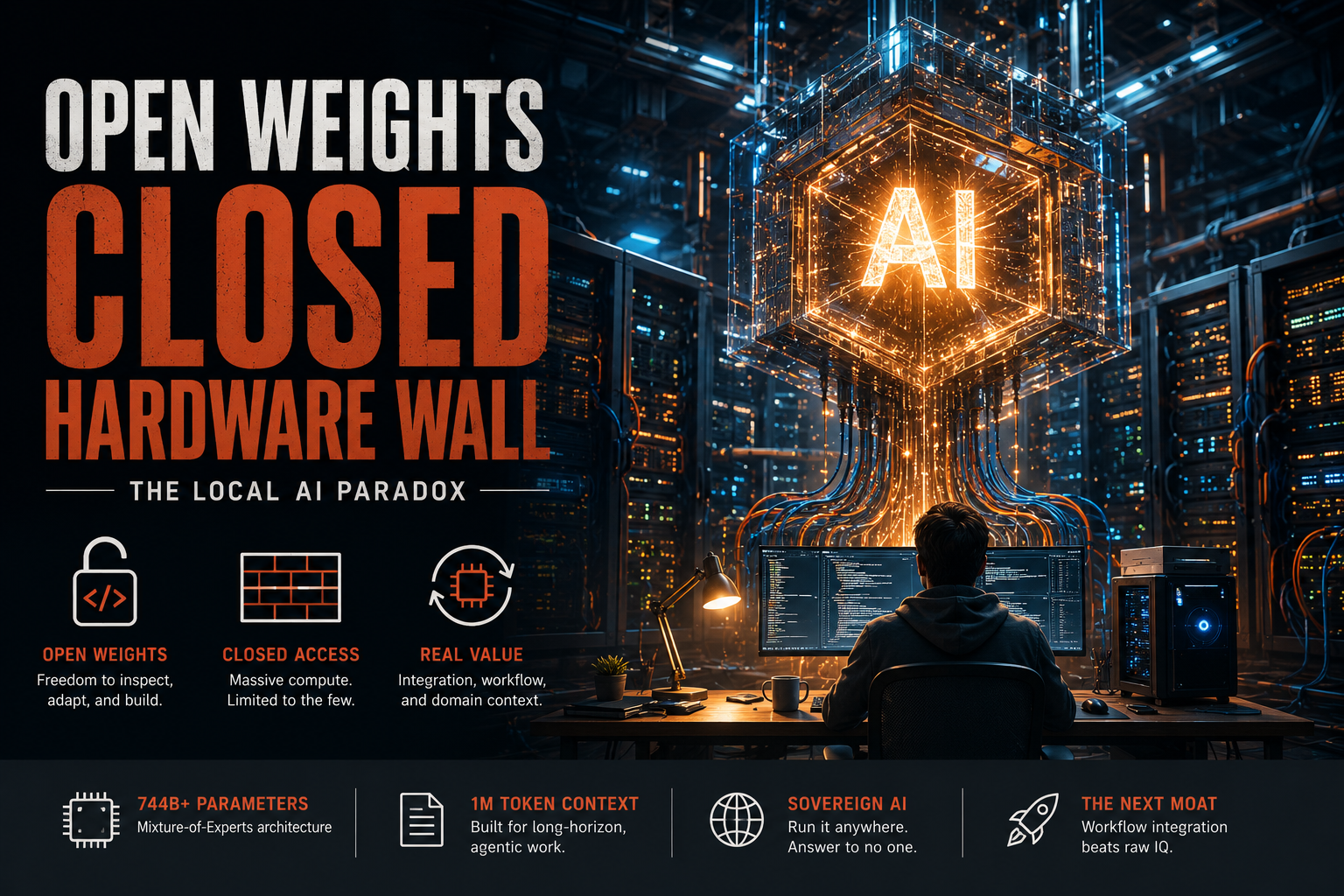
The reports describe GLM-5.2 as a roughly 744B to 753B parameter Mixture-of-Experts model, with about 40B to 44B active parameters per token. That architecture matters because it lets the model carry a huge total capacity while only activating a smaller slice of the network for each step.
The other headline is context. GLM-5.2 is reported as a 1-million-token model, aimed less at casual chat and more at long-horizon work: reading a repository, tracing dependencies, working through multi-file refactors, holding a large document set in view, or driving an agent that needs to remember what it already tried.
The license is the other strategic lever. The reports repeatedly frame GLM-5.2 as MIT-licensed or permissively open-weight, which is a different kind of promise than "available through our API." Open weights mean an enterprise, lab, or country can in principle run, inspect, adapt, and control the model stack without depending on a foreign hosted endpoint.
That "in principle" is doing a lot of work.
The Hardware Wall: Open Weights, Closed Reality
This is the Local AI Paradox: the weights may be open, but the hardware needed to run them is not open to most people.
A hobbyist with a single consumer GPU is not casually running a full frontier-scale model like this at home. The reports cite estimates that full-precision deployment can require data-center-class memory, while heavily quantized setups may still need very large unified-memory machines or multi-GPU rigs. Even if those exact numbers move as inference tools improve, the practical truth holds: "open" does not automatically mean "accessible."
So GLM-5.2 is not a mass-market local AI moment in the simple sense. It is not the model your average small business owner downloads on a Tuesday and runs next to QuickBooks.
But it is still a local-first milestone. A university lab, a large company, a government agency, a defense contractor outside the U.S. stack, or a privacy-sensitive enterprise can treat open weights as strategic infrastructure. They can pay the hardware bill because the payoff is control: data residency, model availability, tuning freedom, and independence from API policy changes.
That is the paradox. Open weights democratize control before they democratize convenience.
The Coding-Agent Angle
The reports consistently frame GLM-5.2 as a coding and agentic-workflow model. That does not mean it is automatically the best daily coding partner for every developer. It means its design target appears to be longer, messier tasks: repository-scale understanding, multi-step debugging, function calling, tool use, and large-context planning.
This is where a model like GLM-5.2 can matter even if a closed model still has better "taste" in ordinary code generation. Coding agents fail when they lose the thread. They forget earlier edits, miss cross-file implications, invent state, or solve the local problem while breaking the system. A huge context window and agent-tuned behavior are attempts to attack that failure mode.
The cautious take is best. GLM-5.2 may be very useful for agentic software work, especially where local control matters. But production reliability still has to be earned in the field. A benchmark can suggest capability. It cannot prove that a model will behave well inside a live codebase with weird dependencies, old decisions, business logic, secrets, tests, deadlines, and humans who will blame the tool when it makes a mess.
For builders, the question is not "can it code?" The question is: can it fit into a workflow with tests, review, rollback, observability, and clear human ownership?
China, Huawei Ascend, And Sovereign AI
The geopolitical piece is hard to separate from the technical one. The reports describe GLM-5.2 as trained or optimized around Huawei Ascend hardware, which matters because U.S. export controls were designed to limit Chinese access to the highest-end Nvidia AI chips.
If Chinese labs can keep pushing competitive models on domestic or non-U.S. compute stacks, the frontier becomes more distributed. That does not mean export controls failed completely, and it does not mean every claim should be accepted at face value. It means constraints can redirect engineering. Scarcity can force efficiency, architectural workarounds, local supply-chain investment, and a more explicit sovereign AI strategy.
For Western users, sovereignty cuts both ways. Open weights can reduce dependence on a Chinese API, but a Chinese-origin model may still raise procurement, compliance, security, or policy concerns in sensitive environments. The reports note Zhipu AI's U.S. Entity List status and related data-risk worries around hosted API use. That makes self-hosting more attractive for some users, but it also makes adoption more complicated.
This is the new shape of AI infrastructure: not just model quality, but where the model came from, where it runs, who can turn it off, what law touches the data, and what hardware stack sits underneath it.
The Real Commoditization Thesis
"Frontier intelligence is becoming a commodity" is a tempting line, but it needs tightening.
Raw intelligence is not free. Training is expensive. Inference is expensive. Hardware is scarce. Talent is scarce. Reliability is hard. Distribution is political. The reports themselves show why the simple version of commoditization is too clean.
The better thesis is this: access to near-frontier capability is spreading faster than the old moat story expected. The ability to rent or self-host strong models is becoming less exclusive. That weakens the idea that only a few U.S. API vendors can offer useful high-end intelligence.
But commoditization does not erase moats. It moves them.
If many teams can access strong-enough models, the scarce thing becomes everything around the model: data pipelines, evaluations, product taste, user trust, workflow design, governance, cost control, security, latency, and domain integration. The model is still important. It just stops being the whole castle.
Why The Next Moat Is Workflow, Not Raw IQ
That is the useful market frame from the reports: the race shifts from who owns the smartest model to who integrates intelligence best into workflows.
This is already visible in real work. A slightly smarter model with no workflow can lose to a slightly weaker model embedded in the right process. The winning system may have retrieval, permissions, human review, evals, logging, data connectors, UI, domain-specific prompts, and a feedback loop that improves the whole machine over time.
For coding, that moat looks like test-aware agents, repo maps, issue triage, safe patching, review loops, CI integration, and institutional memory. For healthcare, it looks like clinical validation, privacy, handoff design, and liability-aware workflows. For finance, it looks like audit trails, source grounding, risk controls, and compliance. For local businesses, it looks like messy spreadsheets, emails, calls, forms, calendars, invoices, and customers finally talking to each other through a sane system.
That is why GLM-5.2 matters even if another model beats it next month. The important signal is not that one model has won. It is that the intelligence layer is becoming more movable, and the value is migrating into how people use it.
What This Means For Local-First Builders
Local-first builders should not read GLM-5.2 as "everyone can now run frontier AI on a laptop." That is the wrong lesson.
The better lesson is that local-first architecture is becoming strategically real at higher tiers. A builder can design systems with a future where sensitive workloads may run on open weights, where models can be swapped, where data does not have to leave the customer's environment, and where the interface is not married forever to one vendor.
That means abstraction matters. Keep prompts, tools, evals, and business logic separate from the model provider. Log what the system did. Build fallbacks. Test the outputs. Treat local inference as one deployment option, not a religion.
For small teams, the near-term answer may still be hosted APIs. That is fine. Hosted models are convenient, fast, and often cheaper than buying hardware. But the architecture should leave room for open-weight models to enter later when the economics, privacy needs, or compliance demands make sense.
Local-first is not just about running the model under your desk. It is about not building your whole business on the assumption that one closed endpoint will always be available, affordable, aligned with your use case, and legally comfortable.
Final Take: The Frontier Is Becoming Movable
GLM-5.2 may not be a universal benchmark champion. That is fine. The more important thing is that the frontier is becoming movable.
It can move across borders. It can move out of one company's API. It can move into enterprise clusters, sovereign stacks, specialized workflows, and eventually smaller local systems as hardware and quantization improve.
Open weights do not mean open access. The hardware wall is real. The benchmark fog is real. The geopolitical complications are real.
The story of GLM-5.2 is not that China won.
It is not that open source won.
It is not that proprietary models lost.
The story is that frontier intelligence is becoming movable.
And once something becomes movable, history suggests it eventually becomes ubiquitous.
Selected Sources
- GLM 5: Zhipu AI 745B LLM | GLM-5.org
- GLM-5.2: Zhipu's 1M-Context Open-Weight Coding Model | ChatForest
- Zhipu AI's GLM-5.2 closes in on closed-source leaders in coding marathons | The Decoder
- Z.ai's open-weights GLM-5.2 beats GPT-5.5 on multiple long-horizon coding benchmarks | VentureBeat
- GLM-5.2 model analysis | Artificial Analysis
- GLM-5 Benchmark Review | LayerLens
- GLM-5.2 Benchmarks 2026 | BenchLM
- Self-Host GLM 5.2 in 2026: Hardware, vLLM Setup, and Cost vs Cloud | oFox
- GLM-5.2 VRAM Requirements & GPU Recommender | Spheron
- GLM-5.2 local running documentation | Unsloth
- GLM 5.2 Release: 1M Context, Coding-First | Codersera
- GLM-5.2 open weights and China API data-risk coverage | Tech Times
- Zhipu statement on U.S. Entity List addition | Global Times
- GLM-5: from Vibe Coding to Agentic Engineering | arXiv
- Zhipu's GLM-5.2 is the new top open model | DeepLearning.AI
- Zhipu AI stock reaction after GLM-5.2 open-source launch | South China Morning Post