Research context & caveats
This brief is strategic technology research, not investment, engineering, legal, or procurement advice. Lunar datacenters sit at the edge of credible planning: enough real work exists to analyze the path, but many claims remain speculative until launch cadence, lunar robotics, ISRU, thermal systems, and optical communications mature together.
1. Executive Summary
The modern AI industry is running into a physical world problem. Frontier training and large-scale inference look digital from the user side, but underneath they require land, firm power, grid interconnection, water or liquid cooling, transformers, high-density racks, specialized labor, and political permission. The growth curve for AI compute is beginning to collide with the slower growth curve of terrestrial infrastructure [31] [43].
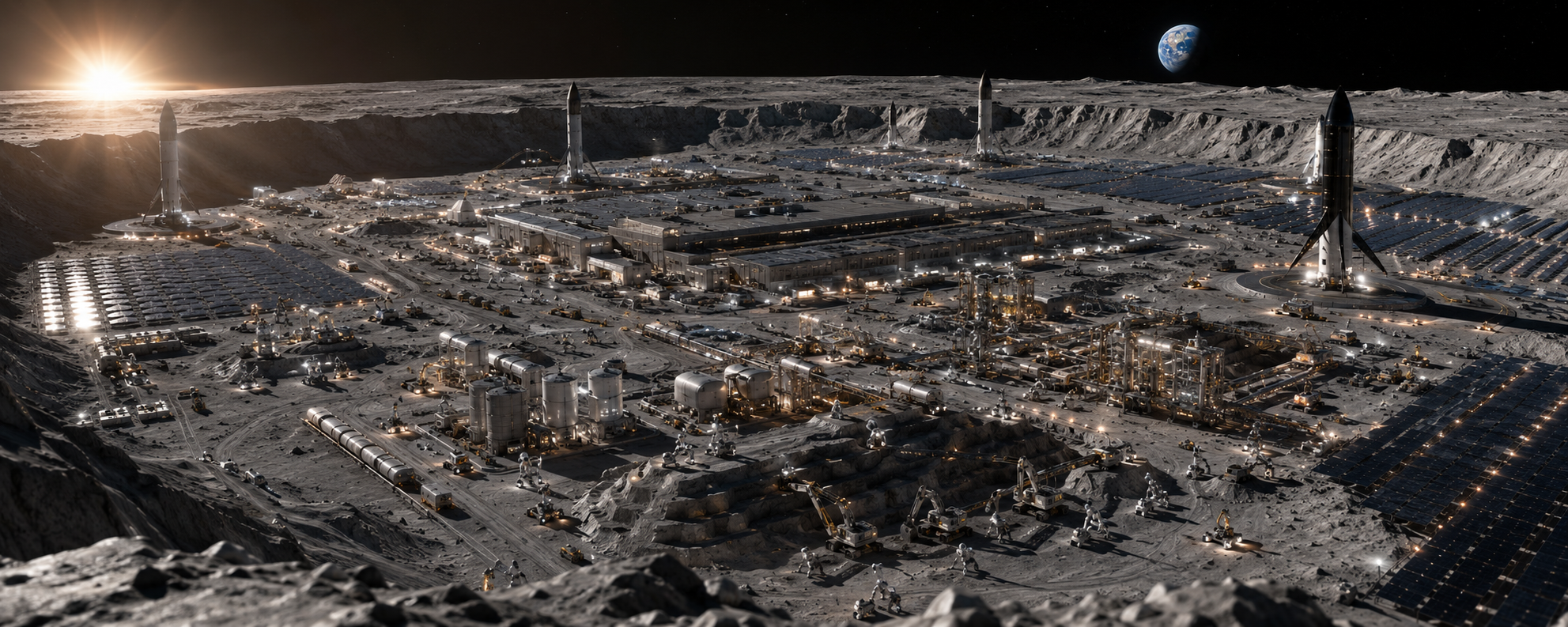
That collision is the reason lunar datacenters deserve a serious, skeptical look. The Moon offers vast land, high solar exposure near polar ridges, proximity to permanently shadowed cold traps, a possible future mining economy, and a clean-sheet environment for secure storage or specialized compute. It also imposes a punishing physics tax: there is no atmosphere for convective cooling, electronics face ionizing radiation, maintenance is remote, latency is too high for real-time Earth applications, and every kilogram of hardware must either be launched or made locally [6] [15] [28].
The right frame is not "lunar AWS." The most plausible lunar datacenter is a specialized node: asynchronous AI training, delayed inference, lunar industrial edge compute, sovereign or archival data storage, scientific processing, interplanetary relay operations, and eventually cryogenic or quantum compute where the lunar environment may be an advantage rather than a penalty [24] [47] [94].
The Moon is not a shortcut around physics. It is a place where some terrestrial bottlenecks get exchanged for harder but potentially more scalable engineering problems.
The synthesis conclusion is balanced. A first pilot-scale lunar datacenter by 2050 is plausible but not likely enough to treat as inevitable. A reasonable probability range is 35-65%, with the lower end reflecting the second report's cooling, radiation, ISRU, and maintenance concerns, and the upper end reflecting the first report's launch-cost and robotics optimism. My synthesized base case is 45% for an operational pilot by 2050, with the most likely first deployment between 2045 and 2055. Commercial-scale lunar compute is more likely a 2060s story unless launch costs fall dramatically, autonomous maintenance becomes reliable, and lunar ISRU moves from experiments to industrial production.
| Question | Best Synthesis | Why It Matters |
|---|---|---|
| Most credible first workload | Asynchronous training, archival storage, lunar edge compute, scientific processing | These tolerate seconds of latency and delayed maintenance better than interactive services. |
| Hardest physics barrier | Thermal management in vacuum | Every watt of chip heat must ultimately be rejected by radiation, not air. |
| Hardest operational barrier | Autonomous maintenance | A failed pump, server, seal, cable, actuator, or radiator segment cannot wait for a convenient human truck roll. |
| Most important enabling stack | Starship-class logistics, humanoid robots, ISRU, nuclear or polar solar power, laser communications | No single breakthrough is enough; the system only works if the whole stack matures. |
| Base-case pilot probability | 45% by 2050, with a plausible 35-65% uncertainty band | The concept is no longer pure science fiction, but commercial economics remain unproven. |
2. Phase 1: The Terrestrial Density Crisis
The case for lunar datacenters starts on Earth. AI datacenters are no longer ordinary server farms. They are industrial power loads organized around dense accelerator clusters, liquid cooling, high-speed networking, backup generation, power conversion, and twenty-four-hour operations. The bottleneck is shifting from "can we build bigger models?" to "can we feed, cool, permit, and maintain the factories that run them?" [22] [27].
The Power and Cooling Wall
High-density AI racks are pushing beyond the comfort zone of traditional air cooling. Liquid cooling, rear-door heat exchangers, direct-to-chip loops, and immersion systems are moving from optional efficiency upgrades to basic requirements for dense clusters [9] [13] [55]. This does not eliminate the heat problem; it moves heat more effectively from silicon into a facility loop, which still has to reject it somewhere.
Water is the political edge of the cooling issue. Evaporative systems can reduce energy use but create local water stress, especially where datacenters are sited on drought-prone land [86] [88]. The more AI infrastructure competes with households, farms, and industry for water and electricity, the more every new campus becomes a civic negotiation rather than a simple real-estate project.
Power is even more fundamental. AI clusters need firm, high-quality electricity at the exact place and time the datacenter needs it. Generation capacity is only one layer. Grid interconnection, transformers, switchgear, substations, transmission corridors, protection systems, and utility approvals can all become gating constraints [31] [43].
NIMBY and Regulatory Bottlenecks
The first report was right to emphasize the regulatory wall. A gigawatt-scale datacenter can look, to nearby residents, less like a tech campus and more like a new industrial plant. Concerns about water, noise, diesel backup generators, land use, transmission lines, local rates, and carbon emissions can delay or kill projects even when capital and chips are available.
This is where the Moon becomes conceptually attractive. It has no neighborhoods, no municipal water board, no local zoning hearing, and no preexisting grid customers who can be priced out. But that "clean slate" is not free. It simply replaces regulatory friction with launch, robotics, radiation, power, thermal, communications, and maintenance friction. The central question is whether those off-world frictions eventually become easier to engineer around than Earth's increasingly crowded infrastructure politics.
3. Phase 2: The Launch Cost Curve
The economic viability of a lunar datacenter is tethered to the cost of moving mass from Earth's gravity well to the lunar surface. Historically, this made the idea absurd. If launch costs stay high, even perfect lunar solar energy cannot offset the capital penalty of shipping datacenter modules, radiators, power systems, robots, shielding, spares, and communication terminals across cislunar space.
The Starship Catalyst
The bullish case depends on fully reusable heavy-lift vehicles. Falcon 9 already reduced launch costs relative to the Shuttle era, but lunar industrial infrastructure needs a larger step: high-cadence, heavy-payload transport where equipment can be launched as industrial hardware rather than miniaturized science payloads [2] [5] [7].
Starship is the obvious catalyst. Its promised economics are still aspirational, but the direction matters. If the cost of delivering useful mass to cislunar space falls by an order of magnitude or more, the mass penalty of radiators, shielding, robotic construction systems, and spares becomes less absurd. It does not become trivial. It becomes modelable.
The conservative case is just as important. If launch remains expensive, low-cadence, or failure-prone, lunar compute stays a government, defense, archival, or prestige niche. The cost per useful flop would be dominated not by GPUs, but by everything a GPU needs to survive: pressure vessels or sealed enclosures, radiation shielding, heat rejection, fault-tolerant power, robotic serviceability, and replacement logistics.
The Mass Penalty Nobody Gets to Skip
The second report's strongest warning is that lower launch costs do not automatically solve lunar datacenters. On Earth, the atmosphere, water systems, roads, technicians, spare-part supply chains, and construction base are already there. On the Moon, each supporting layer has to be imported, built from local resources, or avoided by design.
Thermal hardware is the clearest example. A lunar GPU cluster cannot dump heat into air. It must move heat from chips into a fluid loop, then into a radiator or an advanced heat-rejection system. The heavier that system is, the worse the economics get [15] [25]. That makes launch economics and cooling inseparable. A cheap rocket helps most when it can carry the mass required by physics.
4. Phase 3: Humanoid Robots as Lunar Pioneers
Human construction crews are too expensive, fragile, and life-support-intensive to be the main labor force for early lunar datacenters. The road to lunar compute runs through robotics: autonomous excavators, teleoperated rovers, robotic arms, construction printers, inspection drones, and eventually general-purpose humanoid robots that can use tools and work inside human-designed equipment envelopes [10] [12] [14].
Why Humanoids?
Humanoids are not the right robot for every lunar task. Excavation, hauling, sintering, cable laying, and radiator deployment may be better served by specialized machines. But humanoids matter because datacenter maintenance is a long-tail problem. A facility will need connectors reseated, panels opened, filters or seals replaced, valves adjusted, modules swapped, tools retrieved, cables routed, and weird failures diagnosed.
A human-shaped robot with dexterous hands, good perception, and robust autonomy can use tools and interfaces designed for people. That matters because early lunar infrastructure will likely reuse terrestrial industrial design as much as possible. A rack, pump, fastener, hatch, breaker, and diagnostic panel are easier to adapt for a general-purpose service robot than to redesign entirely for one specialized rover.
Missing Capabilities
Current humanoids are not ready for unsupervised lunar datacenter operations. The gap is not demo dexterity; it is durable autonomy under dust, radiation, low gravity, thermal cycling, communication delay, and ambiguous failure states. The first report's missing-capability list remains the right one, but it deserves sharper framing.
- Dust tolerance: Lunar regolith is abrasive, electrostatically sticky, and hostile to seals, joints, bearings, lenses, and connectors.
- Autonomous repair: A robot has to diagnose whether the problem is mechanical, electrical, thermal, software, or environmental, then execute a repair plan without real-time Earth control.
- Energy discipline: Robots need enough endurance to perform useful shifts, return to charge, survive the lunar night or shadowed sites, and avoid becoming stranded assets.
- Tool use under delay: Earth operators can supervise, but the roughly 2.6-second round-trip lunar latency makes tight teleoperation clumsy [8].
- Fleet reliability: A datacenter is not maintained by one heroic robot. It needs fleet scheduling, spare robots, predictive maintenance, and graceful degradation.
A realistic projection is that robots become useful lunar construction partners before they become fully trusted datacenter technicians. By the mid-2030s, robotic site prep, hauling, inspection, solar deployment, and regolith shielding experiments are plausible. High-autonomy datacenter maintenance is more likely to mature in the 2040s.
5. Phase 4: ISRU and the Lunar Industrial Base
The first report treated ISRU as a support technology. The second report correctly makes it central. If everything must be launched from Earth forever, lunar datacenters remain economically fragile. If the Moon can provide radiation shielding, structural material, oxygen, metals, glass, simple parts, and eventually some semiconductor-adjacent feedstocks, the cost curve changes.
What ISRU Can Realistically Do First
NASA defines in-situ resource utilization as using local materials to support exploration and operations [29]. For lunar datacenters, the first valuable ISRU products are not finished GPUs. They are bulk materials that are expensive to ship and do not need advanced purity: regolith shielding, berms, landing pads, roads, equipment pads, thermal mass, radiation walls, and sintered or printed structural shells [48] [50].
That matters because shielding is heavy. Regolith overburden can reduce radiation exposure and micrometeoroid risk without launching tons of shielding from Earth. A plausible early facility would look less like a glassy science-fiction tower and more like buried industrial equipment: compact modules under regolith, with exposed solar, communications, radiator, and access systems.
Molten Regolith Electrolysis: Promise and Friction
Molten regolith electrolysis (MRE) is one of the more important ISRU pathways because lunar regolith contains oxygen bound in minerals as well as useful elements such as silicon, iron, aluminum, magnesium, and titanium. In principle, MRE can produce oxygen and metals from lunar soil [91] [93].
The challenge is that "in principle" does a lot of work. MRE requires high temperatures, durable electrodes, careful process control, and industrial reliability in low gravity. Reduced gravity can affect bubble detachment and mass transport during electrolysis, which may reduce efficiency or demand redesigned reactors [93]. The early lunar factory is therefore unlikely to produce finished chips. A better expectation is staged maturity: oxygen and simple metals first, construction feedstocks next, higher-purity materials later, and semiconductor-grade manufacturing only after a much larger lunar industrial base exists.
This is why the report's economic center should not be "make GPUs on the Moon." It should be "launch the high-value electronics, make the heavy dumb stuff locally, and gradually localize the industrial base."
6. Phase 5: The Physics Tax: Cooling and Radiation
The Moon is cold in the way a freezer with no air is cold. That distinction is the whole ballgame. A chip does not cool just because the surrounding sky is dark. Heat must travel by conduction into a cooling loop and then leave the system by radiation. There is no atmosphere to carry it away.
The Radiative Cooling Problem
On Earth, datacenters use air, water, refrigerants, and cooling towers to move heat into the environment. In vacuum, the final heat-rejection step is radiative. The Stefan-Boltzmann law is unforgiving: radiated power depends on surface area, emissivity, and the fourth power of absolute temperature. Low-temperature radiators need large areas. Higher-temperature radiators can be smaller, but chips and cooling fluids have material limits.
For power-dense AI compute, radiator area can dominate the architecture. Traditional panel radiators are understandable and reliable, but they are heavy, vulnerable to dust and micrometeoroids, and hard to deploy at the scale implied by a serious GPU facility [25] [28] [63]. This is the strongest argument against simplistic lunar datacenter forecasts.
Liquid Droplet Radiators
The second report's most useful technical addition is liquid droplet radiators. Instead of circulating coolant through heavy metal panels, an LDR emits streams or sheets of tiny liquid droplets into space. The droplets radiate heat while traveling through vacuum and are then collected and recirculated [92] [94].
The appeal is mass efficiency. If an LDR can provide large radiating surface area with less structural mass, it could reduce one of the main lunar compute penalties. The difficulty is operational reliability: droplet containment, collector efficiency, fluid loss, contamination, electrostatic effects, micrometeoroids, pump reliability, freezing risk, and maintenance complexity. LDRs are not magic. They are a promising answer to a brutal thermal equation [92] [95].
The Radiation Barrier
Lunar electronics do not enjoy Earth's atmosphere or magnetosphere. Cosmic rays, solar particle events, and secondary radiation can cause bit flips, latchups, degradation, and permanent damage. High-performance commercial GPUs are not naturally space-hardened [39] [69] [76].
The likely approach is layered rather than singular: regolith shielding, hardened enclosures, error-correcting memory, redundant nodes, checkpointing, fault detection, graceful task migration, radiation-tolerant power electronics, and possibly selective use of lower-performance but hardened processors where reliability matters more than throughput [44] [74] [96]. A lunar AI facility cannot simply be a terrestrial cluster in a pressure box. It has to be a fault-tolerant computing system designed for a noisy radiation environment.
The Cryogenic and Quantum Advantage
The Moon may be hostile to conventional GPU farms but attractive for certain cold-compute workloads. Permanently shadowed regions near the lunar poles can be extremely cold, while nearby ridges may receive high solar exposure. That geographic pairing makes polar sites strategically interesting: power can be generated in sunlight and compute or storage can be placed closer to cold sinks [6] [84].
Quantum and superconducting systems still need precise cryogenic engineering; a cold crater does not replace dilution refrigeration. But the lunar environment may reduce some thermal lift requirements, especially for specialized scientific, quantum, or superconducting compute. This is one reason the most likely long-run lunar use case may be less "run ChatGPT from the Moon" and more "run specialized cold workloads where Earth is inefficient" [94].
7. Phase 6: The Compute Export Problem
Even if we can build a lunar datacenter, the market has to make sense. Compute is only valuable if the results can be delivered to someone who needs them, at a latency, bandwidth, reliability, and price they can tolerate.
Latency and Bandwidth
The Earth-Moon distance creates a latency floor. A one-way signal is roughly 1.3 seconds, with round-trip interaction around 2.6 seconds depending on geometry and routing [8]. That rules out real-time consumer interaction, autonomous driving, high-frequency trading, gaming, live control, and most latency-sensitive inference.
Asynchronous AI training is different. If a model trains for weeks, a few seconds of command latency is irrelevant. Bandwidth still matters, especially for checkpoint transfer, datasets, model weights, logs, telemetry, and results. Distributed training across Earth and Moon would be hard because model-parallel and data-parallel methods often require frequent synchronization [70] [71]. But local lunar training on data already staged there, or delayed batch processing, is more plausible.
Laser Communication
The most credible export path is optical communication. Laser links can support far higher data rates than traditional radio in the right conditions, though they require precise pointing, weather-aware ground stations, relay architecture, redundancy, and careful link budgeting [3] [64] [80]. A lunar datacenter needs the cislunar equivalent of fiber: high-capacity optical relays between the surface, lunar orbit, Earth orbit, and multiple terrestrial receiving stations.
The architecture likely arrives in pieces: laser relay demonstrations, lunar communications networks for Artemis and commercial landers, orbital relay nodes, and eventually dedicated high-capacity compute backhaul. Without that network, lunar compute is trapped in a beautiful building with a bad internet connection.
Refined Use Cases: Not AWS in the Sky
The strongest use cases are the ones that turn lunar disadvantages into tolerable constraints:
- Lunar edge compute: Mining, construction, navigation, science instruments, rovers, habitats, and surface factories will need local processing because Earth latency is too high for tight control.
- Asynchronous AI training: Long-running training or simulation jobs can tolerate delayed command loops if data logistics are solved.
- Sovereign and archival storage: Lunar storage may appeal to governments, institutions, or companies seeking resilience, jurisdictional separation, or disaster-proof archives [1] [6].
- Scientific and interplanetary processing: Lunar farside radio astronomy, Earth observation archives, Mars relay operations, and space-science datasets may benefit from off-world preprocessing.
- Cold and quantum workloads: Cryogenic advantages could make the Moon more attractive for specialized compute than for general cloud services.
8. Phase 7: Timeline Forecast
The first report's timeline is directionally useful but too smooth. The second report's timeline is more conservative and better reflects technology readiness. A credible forecast needs staged gates: launch cadence, robotic operations, ISRU construction, power reliability, thermal demonstrations, radiation-tolerant compute, and optical backhaul.
| Period | Primary Milestones | Compute Implication | Risk Level |
|---|---|---|---|
| 2026-2030 | Starship maturation attempts, Artemis and commercial lunar missions, lunar communications demonstrations, small payload datacenter or storage experiments | Proof-of-concept storage and edge devices, not meaningful AI compute | Very high |
| 2030-2035 | Higher-cadence heavy-lift logistics, robotic site prep, solar and power demonstrations, regolith shielding tests, early ISRU oxygen and materials experiments | Rugged edge nodes for surface missions; datacenter architecture still experimental | High |
| 2035-2045 | Autonomous construction systems, buried modules, optical relay networks, nuclear or polar solar power, first serious thermal rejection trials | Low-density lunar compute serving surface operations and science workloads | High |
| 2045-2055 | Pilot-scale lunar datacenter, fault-tolerant COTS or radiation-tolerant accelerators, liquid droplet or advanced radiators, robotic maintenance fleet | Specialized asynchronous training, simulation, archival, edge, and cold-compute pilots | Medium-high |
| 2055-2065+ | Industrial ISRU, commercial lunar power, mature cislunar optical network, improved autonomous repair, possible quantum/superconducting clusters | Commercial lunar cloud niches; still unlikely to replace terrestrial cloud | Medium |
9. Bottleneck Analysis
The first report ranked logistics and maintenance first; the second report ranked thermal management first. The better synthesis is to separate physics barriers from operational barriers. Thermal management is the hardest physics problem. Autonomous maintenance is the hardest systems problem. Either one can break the business case.
- Thermal management: In vacuum, every watt ultimately exits by radiation. Radiator mass, area, fragility, dust, micrometeoroids, and fluid reliability are the core physics bottleneck.
- Autonomous maintenance: A lunar datacenter must survive failures without a local human operations team. Robots need long-tail repair capability, spares management, and fault diagnosis.
- Launch economics: Starship-class reductions are necessary but not sufficient. The cost that matters is delivered, reliable, installed, maintainable mass on the lunar surface.
- Power generation and storage: Polar solar is attractive, but site geography, transmission, dust, eclipses, and storage still matter. Non-polar sites likely need nuclear power for uptime.
- Radiation and fault tolerance: Commercial accelerators need shielding, redundancy, checkpointing, and error correction to work in a harsher radiation environment.
- ISRU maturity: Local materials are needed to escape the mass trap, but industrial ISRU is early. MRE, sintering, extraction, and manufacturing must prove reliability in low gravity.
- Laser communications: High-bandwidth optical links are essential for data export, telemetry, and command. Weather, pointing, relay redundancy, and network economics remain open.
- Latency-constrained market fit: Real-time Earth services are bad fits. The business case depends on delayed, local, sovereign, scientific, or cryogenic workloads.
- Dust and surface operations: Regolith abrasion, electrostatic adhesion, thermal cycling, and landing debris can quietly destroy uptime.
- Governance and liability: Space law, data sovereignty, export controls, cybersecurity, debris risk, and military sensitivity will shape what can be built and who can use it.
10. Conclusion: The Most Likely Scenario
The most likely road to lunar datacenters is incremental. It starts with terrestrial pressure: AI demand makes power, cooling, land, water, and permitting harder. It continues through launch disruption: reusable heavy-lift makes large industrial payloads thinkable. Then robotics and ISRU create a local construction base. Then power, cooling, radiation shielding, and optical communications determine whether compute can survive as a business rather than a stunt.
The first real facility will probably not be a giant general-purpose cloud campus. It will be a rugged, low-to-moderate-density compute and storage node serving lunar operations, science, archival resilience, and delayed AI workloads. The strongest long-run upside is specialized: asynchronous model training, interplanetary edge compute, sovereign vaults, and cryogenic or quantum systems that benefit from lunar geography.
My synthesized probability estimate is:
- First operational pilot by 2050: 45% base case, with a reasonable 35-65% band.
- Most likely pilot window: 2045-2055.
- Commercial-scale lunar compute: 25-35% by 2060; more plausible in the 2060s if cislunar industry matures.
- Most likely first market: lunar edge compute plus archival/sovereign storage, followed by asynchronous AI and specialized cold workloads.
The strategic recommendation is not to bet on "datacenters on the Moon" as one monolithic idea. Track the enabling stack. Watch launch cadence, delivered-mass pricing, autonomous lunar maintenance, regolith shielding, MRE and other ISRU demonstrations, radiator mass per kilowatt, radiation-tolerant accelerator performance, lunar power systems, and laser-link throughput. If those curves improve together, lunar compute moves from interesting thought experiment to investable infrastructure frontier. If one or two stall, the Moon remains a beautiful place to store a symbolic hard drive and a terrible place to run an AI factory.
Sources
Sources were merged and deduplicated from the two source reports. Low-signal entries were trimmed, while unique high-value additions from the second report were retained for cooling, water stress, quantum/cryogenic compute, molten regolith electrolysis, and GPU memory-error context.
Show 96 merged source links
- The plans to put data centres into orbit and on the moon | BBC
- Launch Cost Deflation and the Economics of Satellite Deployment | Economic Analysis Letters
- Space Communications: 7 Things You Need to Know | NASA
- Economics of Orbital vs Terrestrial Data Centers | Andrew McCalip
- NASA should consider switching to SpaceX Starship for future missions | Reason Foundation
- Is It Lunacy to Put a Data Center on the Moon? | IEEE Spectrum
- Starship's Price Revolution: Timeline, Estimates, and the Real Market Impact | Cyclop Space
- Lowest latency achievable in reliable Earth-Moon communications | Space Exploration Stack Exchange
- Liquid Cooling | Center of Expertise for Data Center Efficiency
- Infrastructure robotics for lunar ISRU, habitat construction and maintenance | University of Arizona
- Liquid Cooling for High-Density Racks | DataSpan
- Robotic Infrastructure Construction and Maintenance Systems for the Moon, Mars, and Other Missions | NASA NTRS
- Liquid Cooling Steps Up for High-Density Racks and AI Workloads | CoreSite
- Automation and robotic systems for lunar base operations | NASA NTRS
- Why Thermodynamics Rules Future Orbital Data Centers | IEEE Spectrum
- Lunar Surface Technology | NASA
- Building beyond Earth: human-robot collaboration in extraterrestrial construction | Frontiers
- Liquid vs Air Cooling for Data Centers | Energy Solutions
- Autonomous Lunar Excavator design and development | Springer
- Towards a future space-based, highly scalable AI infrastructure system | arXiv
- The Thermodynamics of Hype: Why Space Won't Save AI's Energy Crisis Yet | Project Geospatial
- AI Training vs. Inference: Designing Networks for Real-World Workloads | Hedgehog
- The Thermal Wall: Orbital Data Center Cooling | Arkspace
- Solving AI Foundational Model Latency with Telco Infrastructure | arXiv
- Cooling for Orbital Compute: A Landscape Analysis | Space Computer
- A Vision for Industry on the Moon | Space Settlement Progress
- AI training vs. AI inference data centers | Iron Mountain
- Thermal Management in Space | National Space Society / NASA resource
- Overview: In-Situ Resource Utilization | NASA
- Low Latency Inference for Real-Time AI Applications | DigitalOcean
- AI Datacenter Energy Dilemma | SemiAnalysis
- Thermal Control Technology for Space Data Centers | Journal of Refrigeration
- The Future of Autonomous Maintenance and Self-Healing Systems | Llumin
- Impact of Data Center Location on Energy Costs | Datacenters.com
- How do I calculate cooling cost per server? | Server Fault
- Autonomous multirobot excavation for lunar applications | Robotica
- Introduction to Space Datacenters and Orbital Compute | SemiAnalysis
- The quest for commercial-performance electronics in space | HyperX Logic
- The Cooling Crisis Facing Space Data Centers | Compute Forecast
- The Real Constraint on Data Centers in Space | Aravolta
- Measurement of Generative AI Workload Power Profiles for Whole-Facility Planning | arXiv
- Space Data Centers: Promise, Physics, and the Parts That Still Are Not Penciled | Space Ambition
- Using life cycle assessment to drive innovation for sustainable cool clouds | PMC
- AI inference on radiation-hardened satellite processors | Patsnap
- When to compute in space | arXiv
- Autonomous construction of lunar infrastructure with in-situ boulders | Frontiers
- Cost-driven strategies for space-based data centers | SpaceNews
- NASA's Lunar Surface Innovation Initiative | NASA
- Kilowatts to Compute: Data Centers on Earth and in Orbit | Balerion Space
- Innovative robotics for lunar exploration and on-orbit servicing | Frontiers
- Liquid Cooling vs Air Cooling for AI Data Centers | Introl
- GPU-based high-performance computing for radiation therapy | PubMed
- Air vs. liquid cooling for AI-ready data centers | Schneider Electric
- GPU-based High-Performance Computing for Radiation Therapy | PMC
- Run CUDA Workloads in Space with GPU Platforms | Colossus Computing
- GPU Cluster TCO Calculator | Silicon Analysts
- Vapor Chamber vs Liquid Cooling | KenFa Tech
- Orbital Data Centers Explained | BlacKnight Space Labs
- Radiation shield tech could bring high-performance AI chips to space | SpaceNews
- Lunar thermal environment topic collection | Science.gov
- Lunar base thermal management/power system analysis and design | NASA NTRS
- Lasers From Space Promise Fiber Speed | IEEE Spectrum
- CPU demand and AI agents in data centers | Tom's Hardware
- Space-based Laser Communications | Avantier
- A simulation framework for autonomous lunar construction work | arXiv
- Space-Based Data Centers: The Moonshot Worth Betting On | Space Computer
- Radiation tolerant heterogeneous GPU-based onboard data processing | Springer
- Data centers in space: an astrophysicist's look | Aspenia Online
- Does Distributed Training Undermine Compute Governance? | arXiv
- Efficient Training of Large Language Models on Distributed Infrastructures | arXiv
- Decentralized AI Training: Architectures, Opportunities, and Challenges | Galaxy
- Radiation Tolerant SpaceVPX GPU Single Board Computer | Moog
- Radiative cooling technology for data center cooling and energy efficiency | Springer
- Commercial Off-The-Shelf GPU Qualification for Space Applications | NASA NTRS
- Space-Based Data Centres: The Future of AI Computing | AI News Hub
- In-space Servicing, Assembly, and Manufacturing | NASA
- Space-Based Data Centers Could Power AI with Solar Energy, At a Cost | Scientific American
- The transformative technology of laser/free-space optical communications | SPIE
- Notes on Google's Space Data Centers | Angadh Nanjangud
- Starlink's Laser System and Lunar Connectivity | Sesame Disk
- Core Heat Dissipation Methods in Space | Assembtek
- A review of the construction of the supporting energy system for the lunar base | Frontiers
- Why Putting AI Data Centers in Space Doesn't Make Much Sense | Chaotropy
- AI datacenters in space do not have a cooling problem | Sean Goedecke
- Emerging Chemical and Biological Materials Technologies in the Extraplanetary Environment | Springer
- Majority of US's new AI datacenters to be built on drought-hit land | The Guardian
- AI's energy, carbon, water and land footprints | United Nations University
- Data Drain: The Land and Water Impacts of the AI Boom | Lincoln Institute of Land Policy
- Towards a Spaceworthy COTS Graphics Processing Unit | UTEP ScholarWorks
- Fault Detection and Diagnosis in Industry 4.0 | PMC
- Lunar Resources, Inc. molten regolith electrolysis portfolio | SBIR
- Liquid droplet radiator for space applications | Thermopedia
- Modeling electrolysis in reduced gravity | Frontiers
- Sustainable Quantum Computing: Opportunities and Challenges | arXiv
- A Review on Thermal Design of Liquid Droplet Radiator System | Springer
- Understanding the Landscape of Ampere GPU Memory Errors | arXiv