Research context & caveats
This is career strategy, not a guarantee. The roles below are directional maps for where demand may form as AI moves from screens into infrastructure, homes, factories, clinics, and public systems.
The Big Idea
The most useful takeaway from the research is not "learn AI." That advice is too vague now. It is like telling someone in 1998 to "learn the internet." True, but not enough.
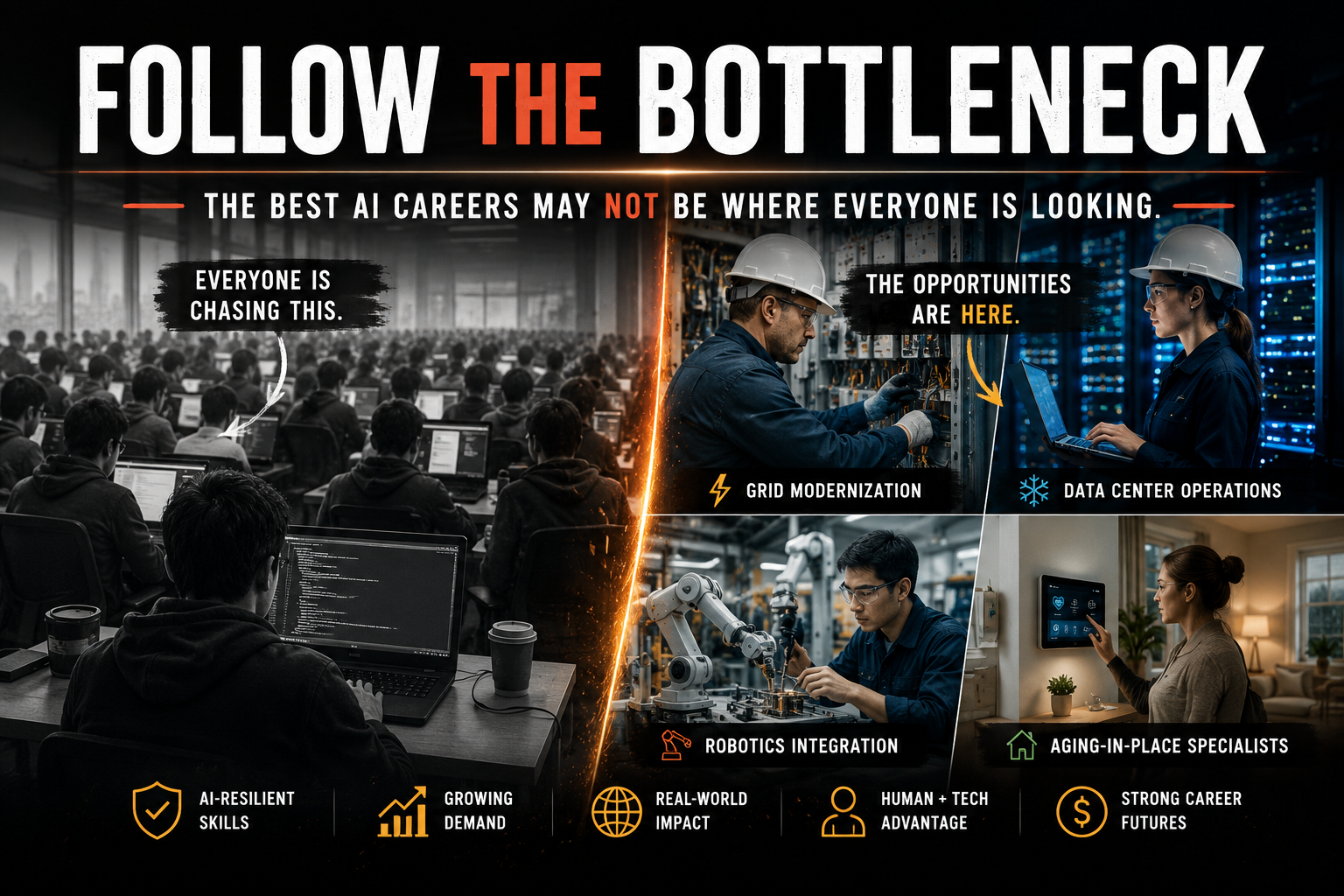
The stronger advice is this: follow the causal chain until you find the bottleneck between AI and the physical world.
AI creates more intelligence, but intelligence is not the same thing as execution. A model can draft a grid plan, optimize a building, route a robot fleet, monitor an aging parent, or flag a compliance risk. Then reality raises its hand. Who installs the equipment? Who keeps the power clean? Who checks the safety case? Who trains the staff? Who explains the system to the client, the patient, the regulator, or the person standing next to the robot?
That is the second-order career map. The AI economy is not creating a shortage of intelligence. It is creating a shortage of people who can connect intelligence to reality.
Why Second-Order Careers Matter
The first-order AI story is about models: chips, data centers, foundation models, agents, and the software companies building on top of them. Those jobs matter, but they are not the whole economy. In fact, many of the biggest constraints are showing up outside the model layer.
Data centers need electricity, cooling, land, transmission, permitting, maintenance, and uptime. Robots need fleet managers, safety auditors, repair technicians, and workflow designers. Aging populations need care coordinators who can combine human judgment with home monitoring, telehealth, and smart devices. Buildings need people who understand both HVAC and software. Regulated organizations need people who can prove an AI system is reliable, explainable, and allowed to be used.
The pattern is simple: AI expands what is possible, then the surrounding physical and human systems become the constraint. Careers form around the constraint.
The Five Great Career Waves of the AI Era
The source reports point to five career waves that look especially important over the next decade. These are not all brand-new job titles. Many are upgrades of existing trades, operations roles, healthcare roles, engineering roles, and compliance roles. That is good news. It means people do not have to guess the perfect futuristic title. They can build on real skills that already matter.
1. Energy
AI is hungry. The more the economy depends on compute, the more valuable the people become who can make power reliable, flexible, and available. This includes grid modernization, power quality, distributed energy resource management systems, substation technology, demand response, and the operational side of data center power.
The interesting career move is not only becoming an electrician or a utility engineer. It is becoming the person who understands how old electrical infrastructure, modern controls, renewables, batteries, data centers, and AI-driven load management fit together.
Watch for roles around smart grid technicians, power quality specialists, substation automation, DERMS operations, data center electrical maintenance, microgrid integration, and demand response coordination. These jobs sit at the place where abstract AI demand becomes actual electrons moving through physical infrastructure.
2. Robotics
Robotics is where AI stops being a text box and starts sharing space with people. That makes deployment harder than demos suggest. A robot in a lab is a technology problem. A robot in a warehouse, hospital, hotel, factory, airport, or construction site is an operations problem.
The bottlenecks here are fleet management, integration, safety auditing, maintenance, and human-robot workflow design. Someone has to decide where the robot should move, what it is allowed to touch, when a human takes over, how workers report issues, and how the system changes without making the workplace brittle.
Good career paths may combine robotics basics with safety, logistics, industrial maintenance, manufacturing, facilities management, or process improvement. The winning profile is not just "robot builder." It is often "robot translator": the person who can help a machine behave usefully inside a messy human environment.
3. Longevity
The longevity wave is less flashy than robots, but probably more intimate. Aging populations will need more support at home, and AI will make more forms of monitoring, scheduling, coaching, companionship, and care navigation possible.
That does not remove the human bottleneck. It sharpens it. Families still need someone who can coordinate care, evaluate tools, protect privacy, notice emotional changes, and help older adults actually use the technology. A dashboard cannot replace trust. A sensor cannot explain a difficult decision to a family.
Career paths here include aging-in-place specialists, gerontechnologists, care coordinators, home health technology consultants, remote patient monitoring coordinators, and longevity program support. The most durable roles will likely combine technical comfort with patience, empathy, and practical knowledge of healthcare systems.
4. Smart Infrastructure
Buildings are becoming operational software platforms. HVAC, lighting, security, occupancy, energy use, water systems, maintenance, and comfort can all be sensed, optimized, and predicted. But buildings are stubbornly physical. They leak, overheat, drift out of calibration, and contain equipment installed across decades.
This wave includes building automation, digital twins, thermal management, predictive maintenance, and facilities analytics. AI can recommend what should happen, but people still need to validate sensors, understand mechanical systems, coordinate vendors, and keep the building usable while upgrades happen.
The opportunity is especially strong for people who can bridge trades and software. A technician who understands controls, networking, HVAC, energy management, and AI-assisted diagnostics may become far more valuable than someone who only knows one layer.
5. Human Oversight
The more AI is used in consequential settings, the more organizations need humans who can verify, audit, explain, and govern it. This wave includes compliance, verification, AI auditing, model evaluation, trust and safety operations, red teaming, policy translation, and human-in-the-loop process design.
This is not only a legal function. It is also an operations function. Companies will need people who can ask: What is the model allowed to decide? What data did it use? When does a person review the output? How do we know it is working? What happens when it fails? Can we explain the decision to a customer, regulator, patient, student, or employee?
Human oversight careers may grow fastest in finance, healthcare, insurance, education, public services, hiring, defense, and any field where an AI error creates real harm. The useful skill is not fear of AI. It is disciplined skepticism paired with enough technical fluency to test the system instead of waving at it from a distance.
The Career Rule: Follow the Chain
The practical method is to start with an AI trend, then keep asking what it depends on.
If AI data centers grow, they depend on energy, cooling, electricians, grid interconnection, land use, maintenance, and operations. If autonomous robots grow, they depend on safety, repair, workflow design, fleet orchestration, insurance, and labor relations. If AI healthcare grows, it depends on privacy, care navigation, clinical validation, patient trust, and staff training.
The farther you follow the chain, the less crowded the career advice becomes. Everybody can see "AI engineer." Fewer people notice the substation technician, the building controls specialist, the robot safety coordinator, the gerontechnology consultant, or the AI compliance operator.
That does not make these jobs easy. It makes them legible. They are places where demand can grow because the world cannot skip the bridge between intelligence and implementation.
What To Learn If You Are Starting Now
For a young person, career changer, or technically curious adult, the map suggests four durable skill stacks.
First, learn a physical system: electrical work, HVAC, industrial maintenance, healthcare operations, logistics, construction, manufacturing, facilities, or energy. Second, learn enough software to work with modern tools: sensors, dashboards, APIs, basic scripting, AI copilots, and documentation systems. Third, learn safety and compliance habits, because the physical world punishes sloppy automation. Fourth, learn how to communicate with people who do not share your specialty.
The best stack is rarely pure AI. It is AI plus a domain where mistakes are expensive.
My Biggest Takeaway
This research accidentally stumbled into a broader idea: the AI economy is not creating a shortage of intelligence. It is creating a shortage of people who can connect intelligence to reality.
That is the line I would want readers to remember. Not "learn AI." Learn where AI gets stuck.
Find the bottleneck between AI and the physical world. Then become useful there.
Selected Sources
- Global energy demands within the AI regulatory landscape | Brookings
- Grid Modernization Initiative | Department of Energy
- Electricity Demand Growth Resource Hub | Department of Energy
- Electricity Demand and Grid Impacts of AI Data Centers: Challenges and Prospects
- AI Data Centers Face Skilled Worker Shortage - IEEE Spectrum
- The United States Needs Data Centers, and Data Centers Need Energy, but That Is Not Necessarily a Problem | ITIF
- Expanding and modernizing the power grid for a clean energy transition
- Grid Resilience: Neglected No More
- Federal Smart Buildings Accelerator Boosts Technology Interest Across Federal Agencies | Department of Energy
- Smart Building Systems Are Cutting Energy Waste, and AI Is Making Them Even Smarter | ACEEE
- How smart buildings use AI to cut energy use and improve health
- IoT-Driven Building Energy Management Systems for Net Zero Energy Buildings
- Commercial Buildings Energy Consumption Survey | EIA
- Thermal management and waste heat strategies for data centers | Johnson Controls
- Power density and thermal management reshape AI data centers | Roland Berger
- Fleet Management Automation 2026 | AI, Robotics and IoT Integration
- Robot Fleet Management Applications and Use Cases | SVRC
- What Is Humanoid Robot Safety? Why Real-World Deployment Is Still Years Away | MindStudio
- 10 humanoid robot companies preparing for commercial deployment | Robotics 24/7
- Opportunities, challenges, and roadmap for humanoid robots in construction | Scientific Reports
- Artificial intelligence and robotics in predictive maintenance | Frontiers
- A Guide to Automation Apprenticeship Programs | A3
- Careers in Aging: Becoming a Gerontechnologist | University of Florida
- From sick care to healthspan: educating the longevity physician for health maintenance and health promotion | PMC
- Certified Geriatric Care Manager | International Commission Health Care Certifications
- The Definition of Jobs in the Data Center Economy Needs to Shift | Commercial Observer
- The hidden job opportunities in data center construction | Skillit
- Liquid Cooling Data Center Careers and Salary | Data Center Geeks
- Preparing the Workforce for Liquid-Cooled Data Centers | LVI Associates
- Power and Smart Grid Engineer: Salary, Skills and Job Description | UC Riverside