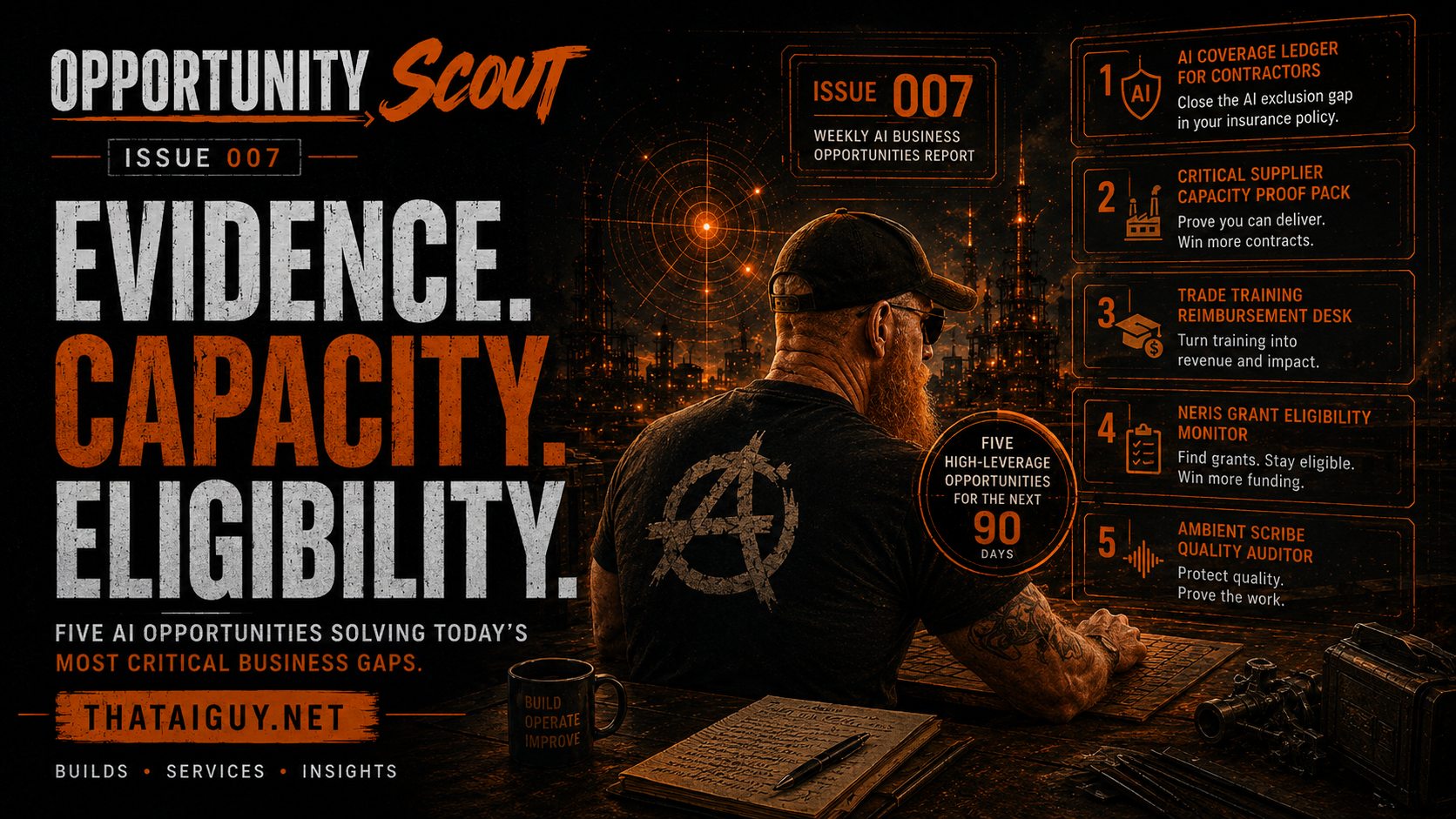
Report context & caveats
This report is a strategic opportunity scan, not legal, insurance, medical, grant, or procurement advice. Validate applicable rules, customer needs, data access, and professional-review requirements before building.
TL;DR
The next useful AI businesses will prove the work.
Companies are adopting AI, pursuing public money, and digitizing operations faster than they can prove that the result is insured, fundable, complete, accurate, or eligible. That creates a practical category of businesses: evidence infrastructure. The best immediate opportunity is an AI Coverage Ledger for Contractors. It connects emerging insurance exclusions to the actual tools and approvals used on a job, giving contractors and their brokers a record they can review before a claim exposes the gap.
AI is getting cheaper. Proof is getting more valuable. A polished output does not tell an insurer how it was produced, a funder whether a factory can deliver, a fire chief whether every dispatch became a valid incident report, or a clinic whether an ambient note quietly dropped something important.
The opportunity is not another general-purpose assistant. It is a narrow system that gathers messy operational evidence, applies deterministic rules, routes uncertain cases to a human, and leaves behind an audit trail. The service can be sold before the platform exists. Each customer engagement then teaches the builder which evidence repeats and deserves automation.
Quick compare: five evidence businesses
| Rank | Opportunity | Best Buyer | Pricing Shape | Scout Rating |
|---|---|---|---|---|
| 1 | AI Coverage Ledger for Contractors | Trade contractors and their brokers | $750-$5,000 setup plus monitoring | 9.2/10 |
| 2 | Critical Supplier Capacity Proof Pack | Small industrial manufacturers | $4,000-$15,000 sprint plus tracking | 9.0/10 |
| 3 | Trade Training Reimbursement Desk | Contractors and manufacturers training workers | $1,000-$3,000 application plus claims | 8.8/10 |
| 4 | NERIS Grant Eligibility Monitor | Volunteer departments and localities | $250-$750 per department plus onboarding | 8.7/10 |
| 5 | Ambient Scribe Quality Auditor | Clinics, consultants, and scribe vendors | $5,000-$20,000 pilot plus usage | 8.4/10 |
Opportunity 1: AI Coverage Ledger for Contractors
Contractors are using AI for takeoffs, estimates, proposals, scheduling, design assistance, marketing, customer messages, and job documentation. Their insurance policies may now exclude claims arising from those tools, even when AI was only one contributing factor. Most owners do not know which policies contain the language, which workflows create exposure, or what evidence a carrier might expect after a loss.
Why now
ISO and Verisk have introduced optional generative-AI exclusions for commercial liability and businessowners coverage. Insurance Journal reported growing carrier interest in three ISO endorsements on July 22. A construction-focused analysis of state filings found 752 filings carrying relevant language across 47 states through June, with hundreds already effective or scheduled to become effective.
Existing solutions and the gap
Commercial brokers and coverage attorneys can interpret policy language. GRC products can inventory software. Project platforms can preserve job records. The missing layer connects all three: a broker-compatible record showing which AI tools touched which project decisions, what source material was used, and where a person reviewed the result.
Build immediately
The 30-day MVP
Sell a paid AI Coverage Readiness Review with a licensed broker or coverage attorney. Upload the policies, identify relevant form codes, inventory AI-enabled vendors, map job-level touchpoints, and produce a review package without claiming to make a legal determination.
- Features: policy extraction, AI-tool inventory, job-use register, human-approval checklist, renewal questions, and a versioned evidence log.
- AI advantage: classify policy language and project activity while linking every conclusion back to its source.
- Suggested stack: Next.js, Postgres, encrypted document storage, OCR, structured clause rules, and a private model endpoint.
- Difficulty: moderate. The first customer should be reachable in one to two weeks.
- Personal fit: 9.8/10 for contractor knowledge, AI implementation, local-first records, research, and useful content.
Revenue and moat
Charge $750-$1,500 for a policy scan, $2,000-$5,000 for contractor implementation, and $149-$399 monthly for monitoring and document retention. The moat becomes a proprietary clause library, construction-specific workflow maps, broker relationships, and anonymized evidence about the controls underwriters accept.
Opportunity 2: Critical Supplier Capacity Proof Pack
Small manufacturers may have the equipment and expertise to expand production but struggle to prove current capacity, identify the binding bottleneck, explain exactly what new capital unlocks, and show a realistic deployment schedule. A grant writer can make the deck attractive. A manufacturing platform can collect machine data. Neither reliably turns shop-floor reality into a concise, defensible capacity case.
Why now
SBA published its Critical Suppliers Prize Competition on July 28. The program offers up to $20 million in total prizes and as much as $6 million to an individual winner. Applicants must already be profitable and creditworthy, deploy funds immediately, and show measurable production improvements within six months. Submissions close August 28, with winners expected around September 10.
Existing solutions and the gap
Grant consultants, Submittable, Instrumentl, accounting firms, and manufacturing systems cover fragments of the job. The opening is a reusable evidence pack spanning grants, lender diligence, customer qualification, and procurement: one governed capacity model tied to source documents and actual production milestones.
Highest upside
The 30-day MVP
Offer a managed capacity sprint to one eligible manufacturer. Build the current-state model, define the post-investment target, identify missing evidence, produce the funder-ready deck, and leave behind a simple milestone dashboard.
- Features: bottleneck diagnostic, capacity model, use-of-funds schedule, six-month milestones, evidence-linked narrative, and risk register.
- AI advantage: reconcile financials, equipment lists, quotes, production logs, quality records, and customer demand documents without inventing claims.
- Suggested stack: secure document portal, Postgres, Python forecasting, spreadsheet ingestion, OCR, and citation-grounded document generation.
- Difficulty: moderate. The August 28 deadline makes a first engagement possible within days.
- Personal fit: 8.7/10 for operations, construction, evidence workflows, AI development, and research.
Revenue and moat
Charge $4,000-$15,000 for a capacity or grant package, then $500-$2,000 monthly for milestone tracking. Avoid percentage-based success fees where funding rules restrict them. Normalized capacity data, shop-floor integrations, industry benchmarks, and a record of projections versus actual output could turn this into a durable standalone company.
Opportunity 3: Trade Training Reimbursement Desk
Small contractors and manufacturers know they need workers. They still miss training money because applications, approved providers, payroll evidence, attendance records, invoices, credentials, and reimbursement claims live in different systems. Full apprenticeship software is often too much for an employer trying to train five people and recover eligible costs.
Why now
Georgia's $5 million Industry-Driven Skills Training Fund opens August 18 and accepts applications through September 16. It reimburses construction, energy, and advanced-manufacturing employers for training new and existing workers. California updated its 2026-27 construction apprenticeship reimbursement guidance on July 28. On July 21, BlackRock, Carhartt, Ford, and Google also launched a national skilled-trades alliance supporting training efforts across 30 states.
Existing solutions and the gap
ApprentiScope, GoSprout, TradeSchool, workforce boards, and training providers manage established programs. The opening is an employer-side managed service that finds the relevant incentive, assembles the training plan, and keeps the reimbursement evidence moving without forcing the owner to adopt an enterprise apprenticeship platform.
Fastest revenue
The 30-day MVP
Start with Georgia. Sell a fixed-price application package, use the first cohort to map every evidence requirement, and turn the recurring pieces into a lightweight client portal.
- Features: eligibility preflight, provider matching, application drafting, training budget, employee checklist, and reimbursement tracker.
- AI advantage: match employer facts to program rules and convert payroll, attendance, invoices, and credentials into claim-ready evidence.
- Suggested stack: a small portal, secure uploads, structured program rules, document generation, and human approval before submission.
- Difficulty: low to moderate. A first customer should be reachable in three to seven days.
- Personal fit: 9.2/10 for contractor operations, useful services, workflow automation, and community building.
Revenue and moat
Charge $1,000-$3,000 per application, $150-$400 per employee for reimbursement administration, or $99-$299 monthly for ongoing tracking. A maintained state-by-state incentive library, approval patterns, templates, and training-provider relationships become the defensible asset.
Opportunity 4: NERIS Grant Eligibility Monitor
Volunteer and small fire departments are reconciling dispatch, EMS, records-management, and the new National Emergency Response Information System. A reporting vendor may submit the record, but the chief still needs to know which dispatches lack reports, which submissions failed, which corrections remain open, and whether the department is currently eligible for funding.
Why now
Virginia tied Aid to Localities funding to NERIS reporting effective July 1 and plans a compliance check in December. The state also offers fire departments up to $10,000 for incident-reporting improvements. Nationally, NERIS announced on July 17 that the system had passed 15 million all-hazards incident reports.
Existing solutions and the gap
The federal portal, ESO, Tyler Technologies, First Due, and state support teams handle reporting or system transition. The opportunity is not another records-management system. It is an independent exception and eligibility layer that sits across the tools departments already use.
Most overlooked
The 30-day MVP
Work with two chiefs and one locality. Ingest CAD and RMS exports, reconcile dispatches to incident reports, flag missing or invalid records, and produce a monthly eligibility report.
- Features: CSV ingestion, missing-incident reconciliation, validation queue, state-specific completeness rules, and grant-eligibility dashboard.
- AI advantage: classify exception causes and explain likely corrections; deterministic rules make the final compliance decision.
- Suggested stack: Python, FastAPI, Postgres, secure file ingestion, validation rules, and a simple web dashboard.
- Difficulty: moderate because vendor exports vary. A first pilot is realistic in two to four weeks.
- Personal fit: 8.4/10 for practical automation, local government, community value, and evidence workflows.
Revenue and moat
Charge $250-$750 annually per department, $1,000-$5,000 for cleanup and onboarding, or $3,000-$15,000 for a county deployment. State-specific rule libraries, CAD and RMS adapters, correction histories, and fire-association distribution create the moat.
Opportunity 5: Ambient Scribe Quality Auditor
Clinics are deploying ambient AI scribes faster than they are building independent quality assurance. A generated note can sound polished while omitting a clinically important detail, assigning words to the wrong speaker, adding an unsupported claim, or creating coding drift. Smaller practices rarely have clinical informatics teams capable of testing these systems continuously.
Why now
The VA reported on July 29 that Ambient Scribe had been deployed to all Patient Aligned Care Team primary-care providers. A July 16 GAO report found that surveyed clinician use of AI-assisted documentation or coding had risen from 21 percent in 2024 to 28 percent in 2026 while warning that accuracy can be difficult to verify. Current research also says audit trails and real-time monitoring will be essential, yet formalized continuous monitoring remains limited.
Existing solutions and the gap
Abridge, Microsoft Nuance DAX, Nabla, Epic, and dozens of smaller vendors generate the notes and operate their own quality programs. Academic evaluation frameworks exist. The opening is a vendor-neutral operational auditor that compares the transcript, AI draft, finalized note, and billing output over time.
Prototype first
The 30-day MVP
Begin with synthetic and de-identified encounters. Compare the transcript, AI draft, and finalized note, then route the most important exceptions to a clinician reviewer. Do not make autonomous clinical judgments or begin with live protected health information.
- Features: factuality, omission, contradiction, coding-variance, specialty comparison, and version-drift reports.
- AI advantage: use a second model to surface unsupported or missing material and prioritize human review.
- Suggested stack: Python, FastAPI, Postgres, encrypted storage, deterministic clinical rules, and HIPAA-capable or on-prem hosting.
- Difficulty: high. A first paid pilot is more realistic in 30 to 60 days with a clinical partner.
- Personal fit: 6.8/10 because the technical fit is good but clinical access, privacy, and validation risk are substantial.
Revenue and moat
Charge $5,000-$20,000 for an evaluation pilot, $1-$3 per monitored encounter, or $500-$3,000 monthly per practice. The durable advantage is a clinically reviewed, specialty-specific error dataset and longitudinal evidence about model drift.
The verdict
Build the AI Coverage Ledger first, but sell it as a professional-review workflow rather than a legal answer machine. In parallel, the Trade Training Reimbursement Desk offers the fastest path to a paid customer because the Georgia application window is opening now. The Critical Supplier Capacity Proof Pack has the greatest standalone-company potential: the same governed capacity evidence can support grants, procurement, lender diligence, and customer qualification.
The broader lesson is simple. As AI makes output abundant, buyers will pay for the systems that show where the information came from, who approved it, whether it meets the rules, and whether the organization can actually deliver. Evidence is not administrative exhaust anymore. It is the product.
Sources and Further Reading
- Insurance Journal: Insurer interest in AI exclusions grows, July 22, 2026
- Verisk: 2026 Businessowners multistate endorsement filings
- Trades Coverage: The AI exclusion hiding in contractor insurance, July 2026
- Gallagher: ISO generative-AI exclusion and construction exposure
- U.S. Small Business Administration: Critical Suppliers Prize Competition, updated July 28, 2026
- SBA: Supply Chain Acceleration and Logistics Enablement Program, July 23, 2026
- Technical College System of Georgia: Industry-Driven Skills Training Fund
- California Division of Apprenticeship Standards: 2026-27 training funds
- Alliance for America's Skilled Trades announcement, July 21, 2026
- Virginia Department of Fire Programs: NERIS guidance and funding eligibility
- Virginia Fire Incident Reporting Grant
- Fire Safety Research Institute: National Emergency Response Information System
- VA News: Ambient Scribe deployment, July 29, 2026
- U.S. GAO: AI for medical notes and coding, July 16, 2026
- npj Digital Medicine: Scaling ambient AI scribes and the need for monitoring