Report context & caveats
This report is a strategic opportunity scan, not legal, tax, engineering, procurement, or investment advice. Validate the applicable rules, technical decisions, integrations, and buyer behavior before building.
TL;DR
Reliability is becoming its own product category.
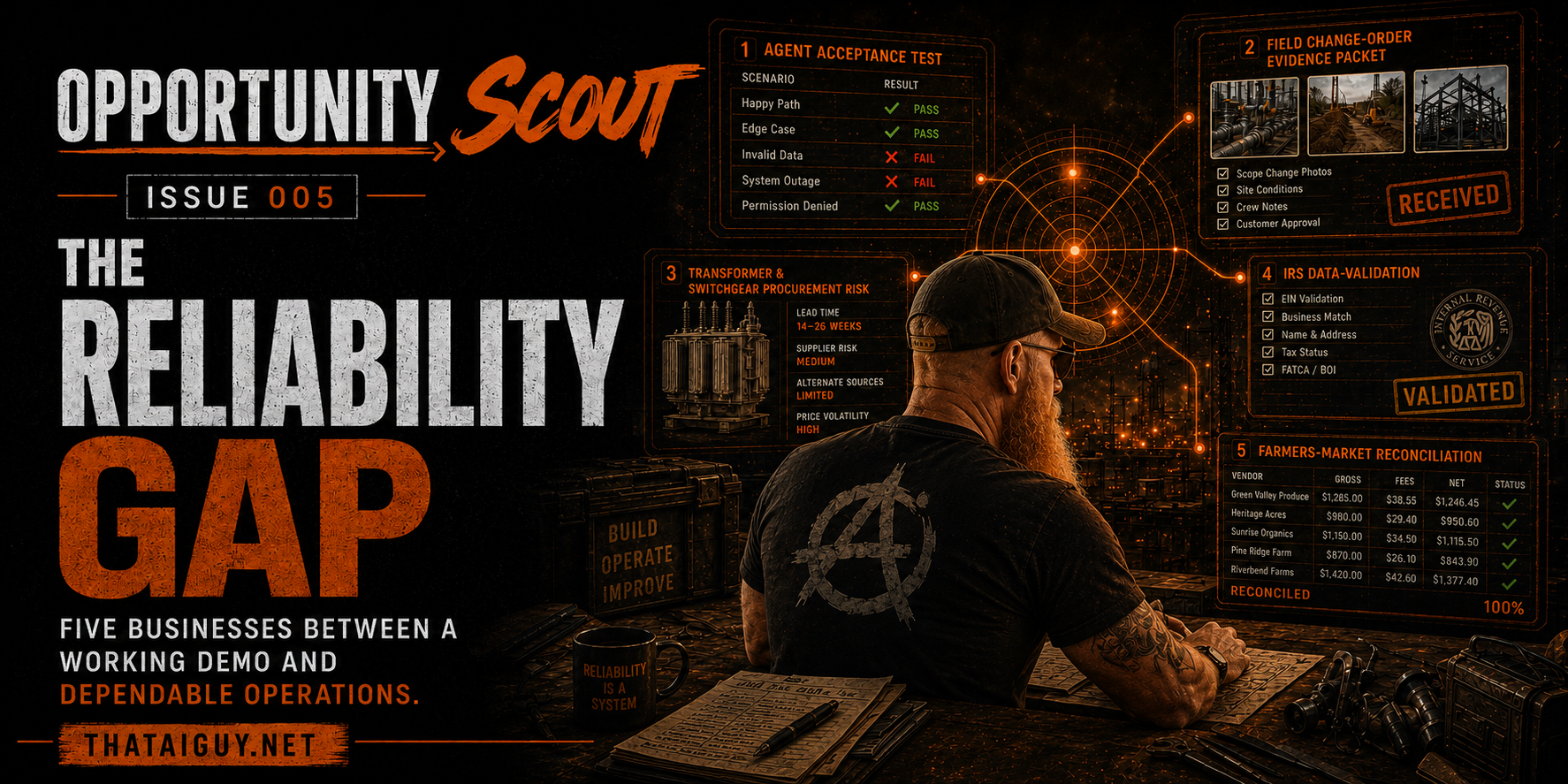
Powerful agents and better document models make it easier to automate work. They do not make the surrounding operation dependable by themselves. Someone still has to test the agent, preserve field evidence, track the long-lead item, validate the tax file, and reconcile the market-day ledger. The best overall opening is an acceptance-test lab for small-business agents. The clearest path to contractor revenue is a field-to-cash evidence workflow. The highest-upside standalone company is an electrical long-lead risk desk.
A working demo used to be the hard part. In August 2026, it is increasingly the beginning of the work. Small teams can create agents in a day. Contractors can collect photos from every job. Buyers can email a dozen suppliers. Accounting systems can export thousands of records. Farmers markets can accept several forms of electronic payment.
Then reality arrives. The agent takes an action it should have escalated. The change-order photo cannot be connected to the person who requested the work. The transformer quote slips another quarter. The IRS file fails validation. The processor deposit does not match the vendor reimbursement sheet.
Those are not glamorous problems, but they are measurable and expensive. They create a useful category for a solo builder or small team: the reliability layer between raw capability and dependable operations.
Quick compare: five places to build
| Rank | Opportunity | Best Buyer | Pricing Shape | Scout Rating |
|---|---|---|---|---|
| 1 | Agent Acceptance Test Lab | Small businesses and AI implementation firms | $2,500-$7,500 audit plus monitoring | 9.2/10 |
| 2 | Field-to-Cash Evidence Agent | Specialty contractors | $149-$399/mo plus onboarding | 9.0/10 |
| 3 | Electrical Long-Lead Risk Desk | Electrical contractors and developers | $1,000-$3,000 audit plus project fee | 8.8/10 |
| 4 | IRIS Transition Validator | Accounting, payroll, finance, and government teams | $750 audit plus migration work | 8.5/10 |
| 5 | Market Day Reconciliation Desk | Farmers markets and program networks | $100-$300/mo or network license | 8.1/10 |
Opportunity 1: Agent Acceptance Test Lab
Small businesses can now build agents faster than they can learn how those agents fail. A booking agent, billing assistant, support bot, or internal workflow may look excellent during a controlled demo. The owner still cannot answer which requests trigger a policy mistake, when an approval is skipped, whether a model update changed behavior, or how much useful work the system completed.
The problem
Existing evaluation platforms are designed for technical teams that understand traces, datasets, graders, and deployment pipelines. Small-business owners and many automation consultants need a simpler outcome: turn this SOP into a realistic test suite, run it, show the failures, and tell me what needs human approval.
Why now
OpenAI launched its small-business program on July 21 after reporting that 78 percent of participants in prior AI Jams built a functional workflow in one day and 42 percent saved more than five hours a week. One day later, OpenAI introduced Presence around policies, simulations, graders, escalation rules, and continuous improvement. Presence is a managed enterprise deployment, which leaves a practical gap below enterprise scale.
Existing solutions and the gap
LangSmith, Braintrust, Arize, Langfuse, and platform-native tools provide strong engineering infrastructure. Enterprise governance products add identity, access, and audit controls. The opening is not another trace viewer. It is a plain-English acceptance testing service for agents built in ChatGPT, n8n, Zapier, voice platforms, or custom apps.
Build immediately
The 30-day MVP
Begin with a paid audit. Ingest an agent's SOP, permissions, and examples; generate 30-100 normal, edge-case, adversarial, and policy-conflict scenarios; run the tests; and deliver a client-readable readiness report plus a reusable regression suite.
- AI advantage: turn plain-English rules into scenarios, expected outcomes, graders, and failure clusters.
- Control layer: preserve test evidence and require humans to approve the rubric, sensitive actions, and release decision.
- Suggested stack: TypeScript, Playwright, Postgres, model APIs, optional self-hosted Langfuse, and HTML/PDF reporting.
- Difficulty: moderate. A first customer should be reachable in one to three weeks.
- Personal fit: 10/10 for AI development, operations, research publishing, and practical education.
Revenue and moat
Charge $2,500-$7,500 for an acceptance audit, $249-$999 monthly for regression testing, and $1,000-$3,000 for periodic red-team exercises. White-label the service for automation agencies. The moat becomes a library of real failures, test cases, and performance baselines organized by industry and workflow.
Opportunity 2: Field-to-Cash Evidence Agent
Specialty contractors regularly perform extra work based on a text, email, marked-up drawing, photo, or conversation in the field. By billing time, someone in the office has to reconstruct what changed, who requested it, when notice was given, which labor and material were used, and whether the work ever reached the pay application.
The problem
The evidence usually exists. It is simply scattered across phones, inboxes, daily reports, and project portals. That delay converts valid work into disputed, rejected, or forgotten revenue. Billd's latest survey says subcontractors wait an average of 51 days after submitting a pay application, while 64 percent report being slow-paid by their general contractor.
Why now
Construction AI is moving from generic search into daily logs, RFIs, submittals, and contract review. Procore announced 20 new agents on July 23, validating the workflows. The opportunity is to serve smaller subcontractors that cannot justify a major platform rollout or must work inside whichever portal the general contractor chooses.
Existing solutions and the gap
Procore, Raken, Siteline, Levelset, and trade-specific ERPs cover pieces of billing, field reporting, waivers, and change-order tracking. The missing wedge sits upstream: automatically convert messy field communications into a reviewable change event and export it to the systems already in use.
Highest probability
The 30-day MVP
Give each contractor a dedicated email, text, or photo inbox. Classify every item by job and change event, extract T&M details, assemble a dated evidence timeline, ask for missing information, and generate a weekly "performed but not billed" report.
- AI advantage: read messages, photographs, drawings, and tickets; connect them into one chronology; and draft a change-event notice.
- Control layer: expose uncertain dates and missing approvals rather than inventing them. Keep contract interpretation and legal decisions with people.
- Suggested stack: mobile PWA, email or Twilio intake, Postgres, object storage, vision/OCR, and server-side PDF generation.
- Difficulty: moderate. Contractor relationships could produce a first customer in one to three weeks.
- Personal fit: 10/10 for construction experience, field operations, and AI-assisted workflow design.
Revenue and moat
Charge $500-$1,500 for onboarding and $149-$399 per month, or offer a $1,000-$3,000 managed documentation service. The moat is field adoption, a library of GC-specific requirements, and outcome data connecting weak evidence with rejected or delayed billing.
Opportunity 3: Electrical Long-Lead Risk Desk
A transformer, breaker, or switchgear package can hold up an entire project. Smaller electrical contractors and commercial developers often manage that risk through vendor emails and spreadsheets, without a normalized view of required specifications, approved manufacturers, quoted lead times, substitution options, and testing or shipping milestones.
The problem
Electrical equipment represents a relatively small portion of total project cost but can control the completion date. Buyers have to understand whether an available unit is truly equivalent, whether the engineer and utility will accept it, and whether a quoted production slot is real. Those are technical, relationship-heavy decisions with poor shared data.
Why now
The Department of Energy's July 9 transmission study says load growth from data centers, manufacturing, and large industrial users is creating a pressing need for new infrastructure. On July 16, a national-laboratory report put typical large-transformer procurement at 2.5-3 years and up to five years for extra-high-voltage units. It also cited roughly 80 percent import reliance and transformer prices rising about 80 percent in 2025.
Existing solutions and the gap
Maddox and Sunbelt Solomon stock and refurbish equipment. Equiptra and specialist brokers match large assets with buyers. The opening is not another generic marketplace. It is a contractor-facing control tower that finds schedule exposure early, compares quotes and specifications, and prepares an approved-equivalent substitution package.
Highest upside
The 30-day MVP
Start as a managed procurement-risk service. Upload an equipment schedule, BOM, submittal, and vendor quotes. Return a normalized critical-item register, lead-time risk ranking, RFQ tracker, approved-manufacturer matrix, and a draft substitution comparison.
- AI advantage: parse one-lines, schedules, specifications, quotes, and submittals; detect mismatches; and draft comparison documents.
- Control layer: qualified engineers, utilities, and authorities must review every technical equivalency.
- Suggested stack: TypeScript web app, Postgres, document OCR, email ingestion, supplier feeds, and human verification.
- Difficulty: medium-high. Supplier access and technical trust put first revenue at roughly three to eight weeks.
- Personal fit: 9.4/10 for construction, infrastructure, research, and operational problem solving.
Revenue and moat
Charge $1,000-$3,000 for a project risk audit and $500-$2,000 monthly per active project, then add portfolio subscriptions or disclosed brokerage fees. Verified supplier response data, actual lead-time history, specification knowledge, and trusted relationships make this the most defensible standalone-company opportunity in the issue.
Opportunity 4: IRIS Transition Validator
Accounting firms, municipalities, universities, financial institutions, and payroll operators with custom FIRE exports must move to the IRS Information Returns Intake System. IRIS uses different CSV templates or an XML-based application-to-application process, along with new transmitter codes, testing, corrections, and error handling.
The problem
End-to-end filing providers already support IRIS. The exposed buyer is the organization that wants to preserve its internal preparation workflow but has not proven its export, mapping, testing, or correction process. Finding those incompatibilities during January filing season would be expensive.
Why now
The IRS reiterated on July 1 that IRIS will be the only information-return intake system for filing season 2027. Its 2026 instructions say a transmitter-code application typically takes up to 45 business days. On July 16, the agency published tax-year 2026 assurance-testing examples for application-to-application developers. The migration work is now concrete.
Existing solutions and the gap
The free IRS portal, Tax1099, 1099FIRE, Morado, and other providers can submit returns. The opportunity is a vendor-neutral preflight and conversion layer for organizations with established source systems, custom reports, or unusual filing volumes.
Deadline business
The 30-day MVP
Do not transmit live tax returns in version one. Convert a legacy export into current IRIS CSV templates, validate fields and formats deterministically, explain errors, generate test files, and deliver a TCC and correction-workflow readiness checklist.
- AI advantage: map legacy field definitions, explain rejection codes, compare documentation, and generate edge-case tests.
- Control layer: use IRS schemas and business rules for validation. AI should explain the error, not decide whether the return is correct.
- Suggested stack: local-first Electron or Tauri app, TypeScript, SQLite, CSV/XML validation, and encrypted local storage.
- Difficulty: moderate. CPA, payroll, and municipal-finance channels could yield a first customer in two to four weeks.
- Personal fit: 8.2/10 for local-first software, operations, AI development, and deadline-driven research.
Revenue and moat
Sell a $750-$2,000 readiness audit, $2,000-$10,000 custom migration, or $99-$499 seasonal validator subscription. The durable asset is a maintained library of mappings, test cases, error explanations, and edge cases across forms and legacy exports.
Opportunity 5: Market Day Reconciliation Desk
Farmers markets accepting SNAP, incentives, credit cards, tokens, and vendor reimbursements can finish a successful market day with several systems that still do not add up neatly. Managers combine processor exports, handwritten token sheets, Square reports, vendor claims, and grant spreadsheets to close the books.
The problem
Payment acceptance is increasingly digital. The back office often is not. Totals have to be reconciled across benefit programs, deposits, incentive matches, and vendor reimbursements. The work is too specialized for generic accounting software and too small for a custom enterprise implementation.
Why now
USDA posted a Mobile Payments Solution for SNAP Authorized Farmers cooperative agreement on July 8, expecting three awards with an award ceiling of $4 million. The application window closed July 31, creating a near-term partner channel through funded nonprofits and universities. MarketLink reports more than 6,000 farmers and markets assisted since 2020 and $46 million in SNAP sales through TotilPay in 2024, up 16.4 percent year over year.
Existing solutions and the gap
TotilPay processes SNAP and integrates with card providers. MarketLink supports authorization and equipment. Boothra covers vendor and market operations. The overlooked opening is the reconciliation layer across payment types, incentives, tokens, reimbursements, and funder reports.
Most overlooked
The 30-day MVP
Import TotilPay and Square exports, photograph or upload token sheets, match processor deposits with vendor reimbursements, flag duplicated or missing entries, and generate market-day closeout plus monthly incentive and grant reports.
- AI advantage: digitize handwritten sheets, classify exceptions, match claims with transaction batches, and draft narrative funder reports.
- Control layer: deterministic reconciliation rules must control every financial total.
- Suggested stack: offline-capable PWA, TypeScript, Postgres or DuckDB, OCR, encrypted storage, and configurable report templates.
- Difficulty: moderate. Market associations and grant awardees put first revenue at roughly four to eight weeks.
- Personal fit: 7.8/10 for local operations, agriculture, research, and community building.
Revenue and moat
Charge $100-$300 monthly per market, $500-$2,000 for onboarding, or $10,000-$30,000 for an annual network license. Program-specific reconciliation rules, funder-approved report templates, offline reliability, and relationships with market networks create the moat.
Verdict: sell the test before building the platform
The Agent Acceptance Test Lab is the best opportunity this week because the market is being created in real time. Agents are becoming easier to build and share, while the disciplines required to test, approve, and monitor them remain concentrated in technical and enterprise teams.
The first offer should be a fixed-price acceptance audit, not a new observability platform. Pick one agent, turn its operating rules into 50 realistic scenarios, run the suite, document the failures, and leave the customer with a reusable release gate. In parallel, interview specialty contractors about field-to-cash evidence. That wedge has the strongest personal distribution advantage and the fastest route to measurable recovered revenue.
The larger pattern matters more than any one product. As AI makes capability cheaper, businesses will pay for systems that make the result repeatable, reviewable, and safe to use. The demo gets attention. Reliability gets the contract.
Sources and Further Reading
- OpenAI: Introducing the ChatGPT for small business program, July 21, 2026
- OpenAI: Introducing OpenAI Presence, July 22, 2026
- LangSmith Evaluations
- Braintrust: AI agent evaluation
- Procore: Digital Coworker packages and 20 construction agents, July 23, 2026
- Billd: 2026 National Subcontractor Market Report, June 23, 2026
- Siteline: subcontractor billing and documentation requirements
- Department of Energy: 2026 Draft National Transmission Needs Study, July 9, 2026
- National Laboratory of the Rockies: Large power transformer supply-chain challenges, July 16, 2026
- Maddox: in-stock and remanufactured transformer supply
- Equiptra: electrical equipment marketplace and matching
- IRS: FIRE retirement and IRIS transition update, July 1, 2026
- IRS: 2026 General Instructions for Certain Information Returns
- IRS: IRIS Assurance Testing System examples, updated July 16, 2026
- USDA: Mobile Payments Solution for SNAP Authorized Farmers, July 8, 2026
- MarketLink: SNAP sales and technical-assistance impact
- TotilPay: MarketLink payment-processing program
- Boothra: farmers-market and vendor operations software