Issue 009 · Evidence workflows & measurable value
The Work That Makes It Count
Five service-first businesses in import handoffs, construction pilots, cyber reporting, and proving what technology actually delivers.
Ideas
Plain-English thinking on AI, automation, and what's actually happening out there.
Substack
It is the faster rhythm next to the long-form briefs: a recurring scan of progress in medicine, energy, robotics, AI infrastructure, scientific discovery, and practical human capability.
Opportunity Reports
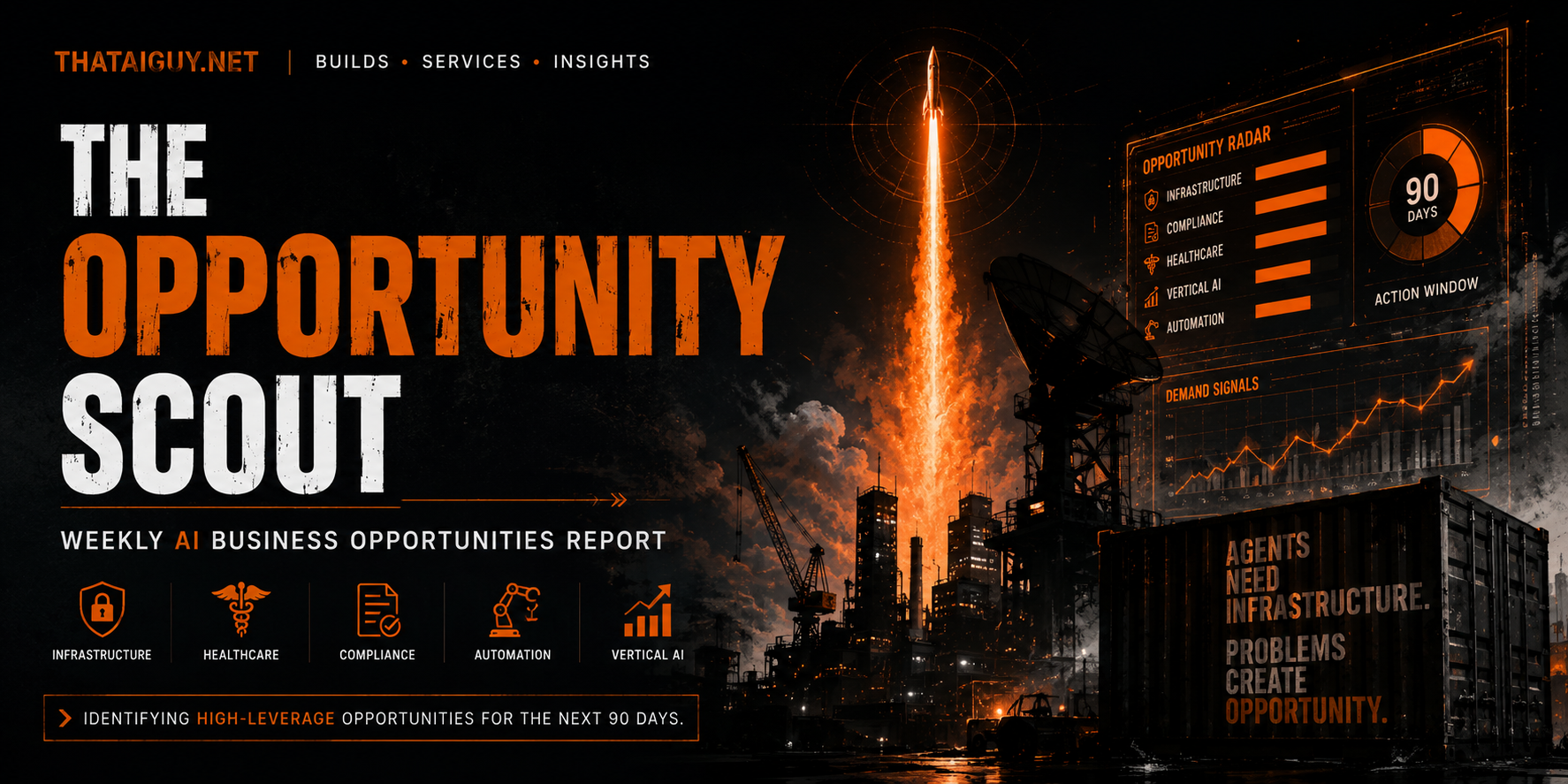
Practical AI business opportunities hiding in infrastructure, compliance, automation, and other unglamorous gaps where demand is already forming.
Investment Research
Source-rich company briefs for personal research and discussion. These are separate from active project pitches and are not financial advice.
Vol. 002 · The Metals Company
A current thesis on TMC as a deep-sea critical-minerals proxy: NOAA permitting, the April 2025 policy shift, Pacific OCS lease momentum, Allseas execution, financing risk, and the milestones that matter.
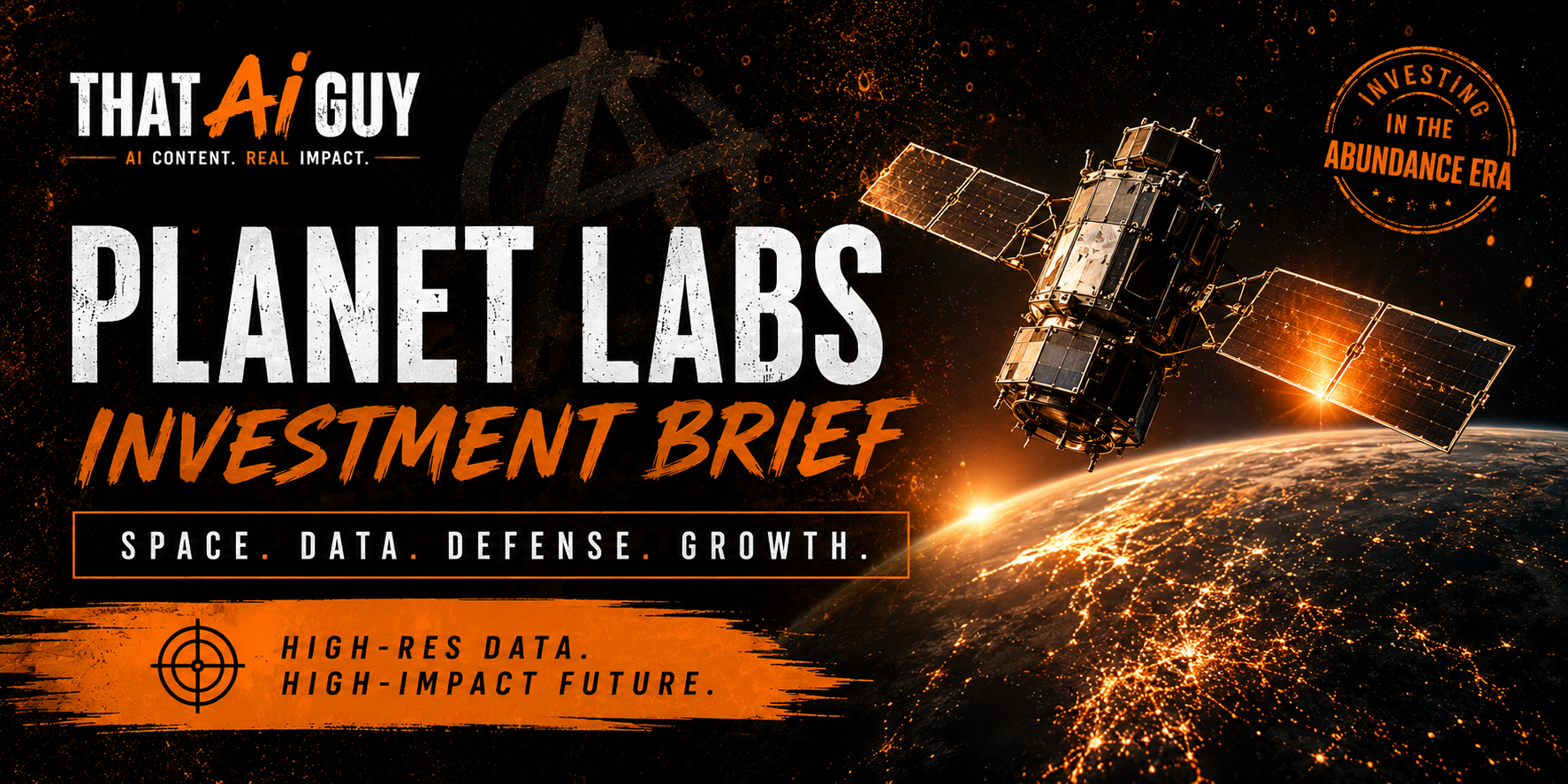
Vol. 001 · Planet Labs PBC
A 5-10 year thesis on Planet Labs as a daily Earth-observation data platform: moat, defense demand, profitability path, valuation discipline, and quarterly watchlist items.
Deep Research
AI-assisted research dives, edited into plain-English briefs with source links kept intact.
AI infrastructure · Research brief
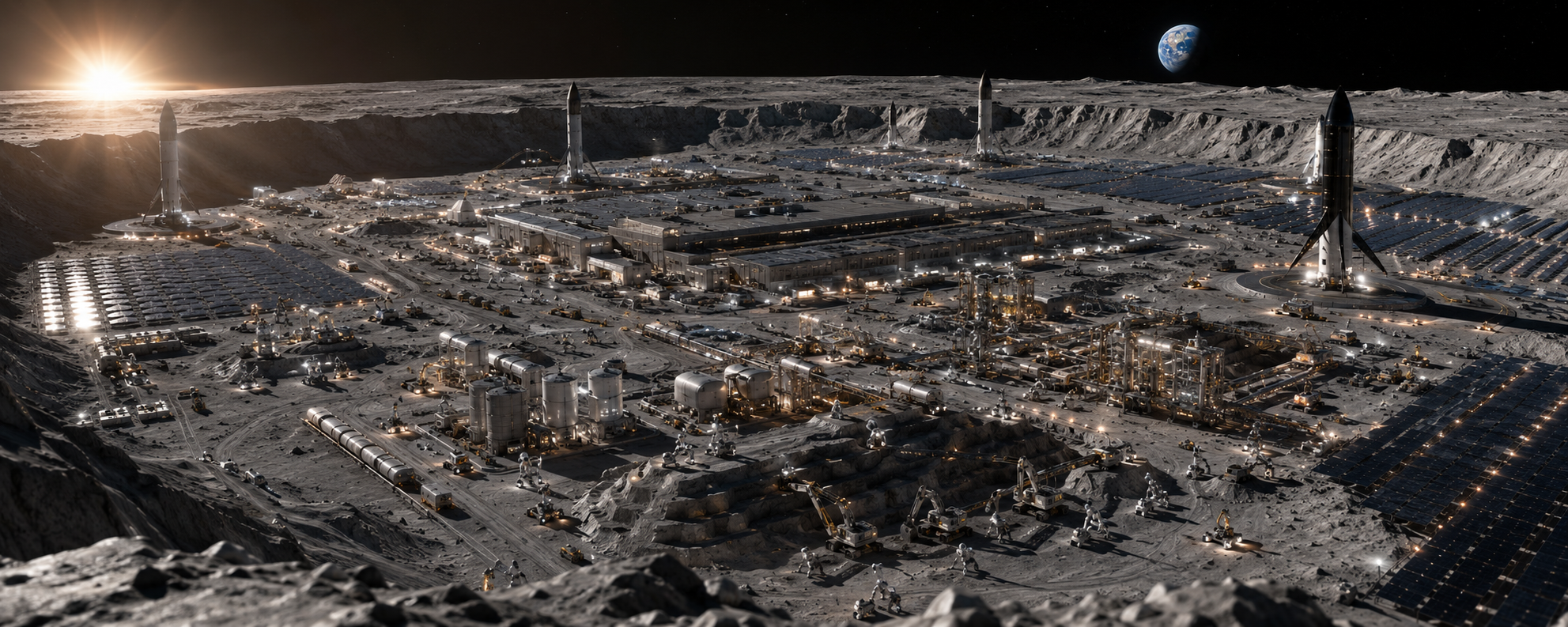
A sober roadmap for off-world AI compute: why Earth is getting squeezed, why the Moon is technically brutal, and what has to mature before lunar datacenters become more than a stunt.
AI strategy · Research brief
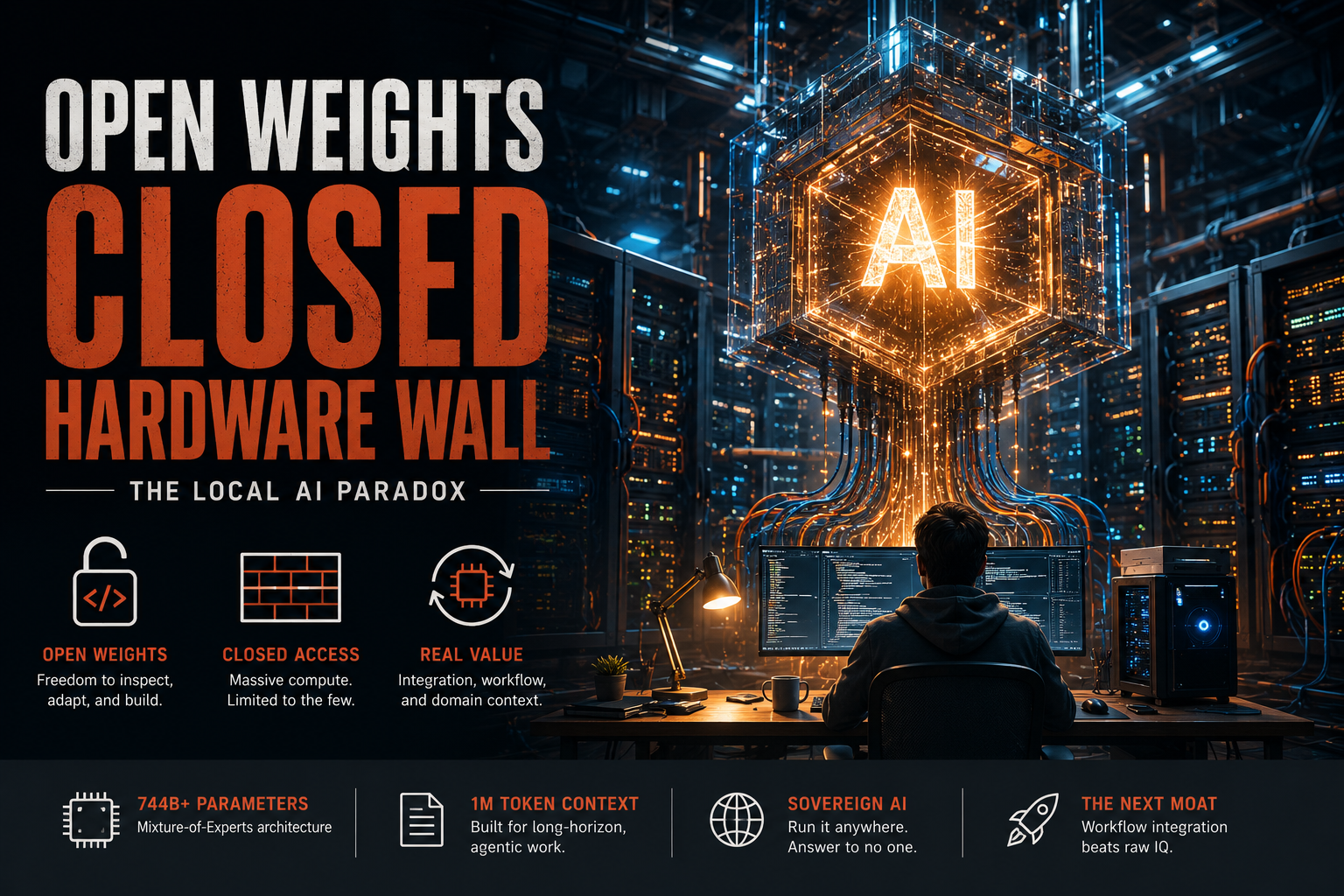
A sober read on open weights, the hardware wall, coding agents, sovereign AI, and why the next moat may be workflow instead of raw model IQ.
Future of work · Research brief
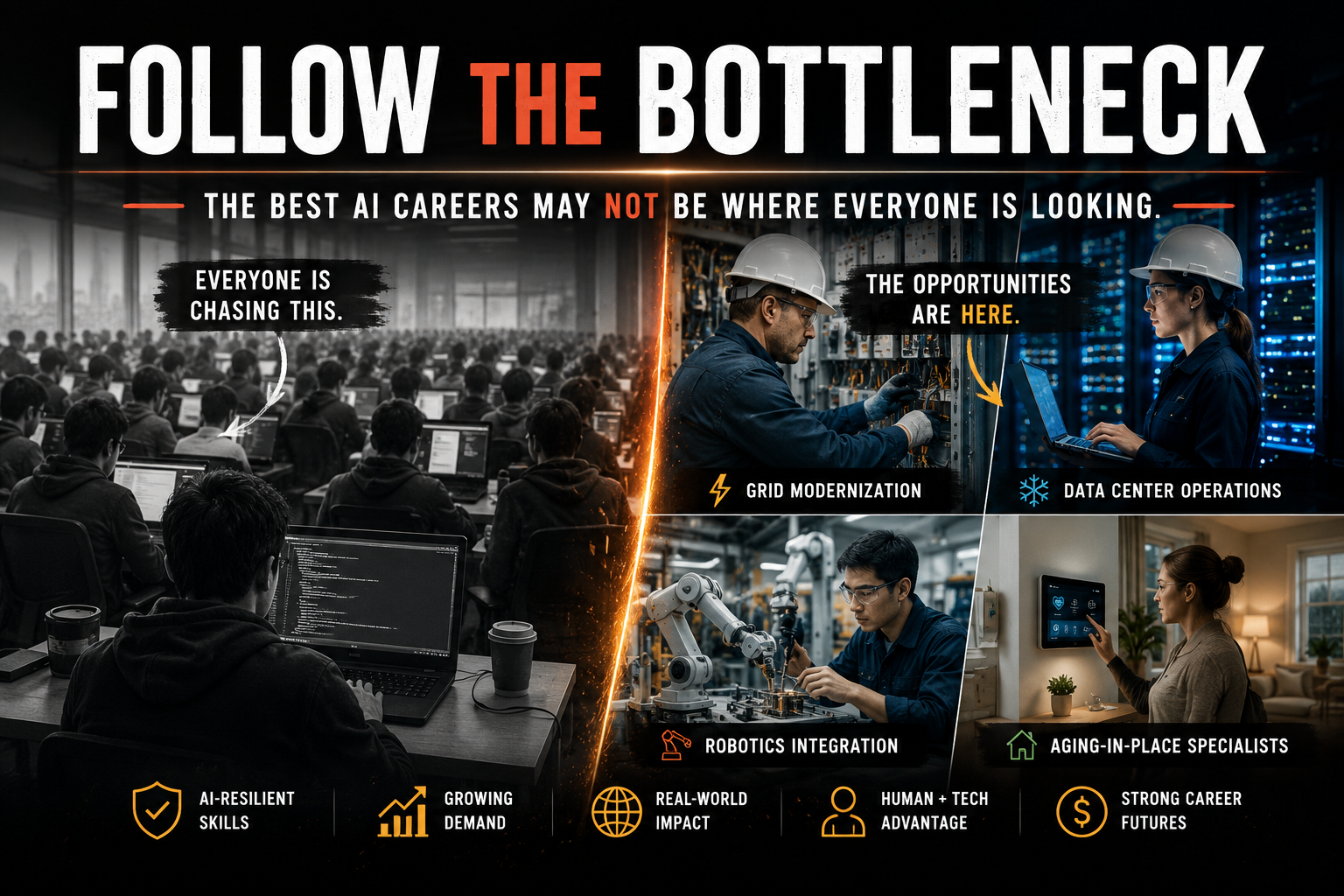
A practical frame for AI-era careers: find the bottleneck between AI and the physical world, then build skills where intelligence has to become real work.
Mental health · Research brief
A compassionate look at AvPD as a shame-driven protection system, plus a careful argument for AI companions as practice bridges rather than human replacements.
AI society · Research brief
A sharper frame for technology backlash: people often do not fear the tool itself, but the loss of agency, status, livelihood, place, and dignity that can come with it.
AI infrastructure · Research brief
A flagship synthesis on the physical stack beneath AI: copper, rare earths, energy, grid infrastructure, compute, data centers, models, agents, applications, and robotics.
Copper markets · Research brief
A two-report synthesis on the copper supercycle thesis, separating FCX as the core risk-adjusted holding, SCCO as the low-cost reserve vault, and BHP as the defensive diversified anchor.
Medical technology · Research brief
A calibrated roadmap for spinal micro/nanorobotics, separating near-term soft-tissue delivery from harder unsolved problems in bone, debris clearance, swarm control, and safety.
Public health · Research brief
A source-rich brief on AI healthcare, mental health access, personalized medicine, and how Dialogs in Faith models reflective AI with honest boundaries.
Future of work · Research brief
A source-checked investigation into emerging AI-era professions, with salary precision and probability claims softened where the evidence is still developing.
DIY solar hardware · Research brief
A hardware-focused companion brief for technically capable SWFL homeowners, comparing solar architectures, inverter and battery stacks, wind-rated mounting, electrical protection, and critical-load backup design.
AI markets · Research brief
A research brief on the companies and business models that may benefit when AI adoption slows: compliance-heavy incumbents, liability insurers, auditors, luxury brands, and human-accountability businesses.
Clearer than the headlines
AI has real risks and real costs. The useful conversation is about separating theatrical panic from practical concerns, measuring impacts honestly, and building better habits, tools, and infrastructure as the technology matures.
Every major technology shift — from the Luddites smashing looms to fears around computers and factory automation — has triggered similar anxieties. History shows the reality is usually more nuanced and ultimately human: technologies automate specific tasks, not entire jobs, while reshaping roles around uniquely human strengths like judgment, creativity, taste, empathy, communication, and coordination.
AI follows this pattern. It excels at routine cognitive work (data entry, basic analysis, drafting, summarization), but struggles with the full complexity, context, and accountability most jobs require. Many roles are being augmented and transformed rather than eliminated. Recent evidence from 2025–2026 studies shows AI-adopting companies and industries experiencing productivity gains, wage growth in many sectors, and more job reshaping than outright replacement.
New opportunities are emerging around AI itself: prompt engineering and orchestration, model evaluation and red-teaming, AI ethics and governance, high-quality data curation, synthetic data creation, specialized domain expertise for training, and integration of AI into existing workflows. Sectors with heavy routine work (clerical, basic coding, customer support) face more disruption and transition challenges — especially for entry-level positions — but the broader trend points to transformation, new demand, and economic growth rather than mass unemployment.
The key variable isn’t AI taking jobs. It’s how quickly people and organizations adapt, upskill, and redesign work around human-AI collaboration.
Current systems are powerful pattern learners and predictors trained on massive amounts of data. They can be astonishingly useful, but they do not possess consciousness, lived experience, emotional depth, or consistently reliable reasoning.
In my view, much of what feels like growing intelligence comes less from the raw models themselves and more from the harnesses and frameworks we build around them — sophisticated prompting techniques, agentic scaffolds, tool integration, memory systems, and retrieval pipelines. These structures make AI appear significantly smarter and more capable than the underlying model would be on its own.
Progress is real, and capability jumps deserve attention. But timelines for AGI are speculative, and claims of imminent consciousness or takeover are often closer to marketing, fundraising, or science fiction than sober engineering.
Bias is real. Large language models absorb patterns from vast human-generated training data, cultural internet content, editorial choices by developers, and safety alignment processes. This can lead to noticeable skews on politically charged topics.
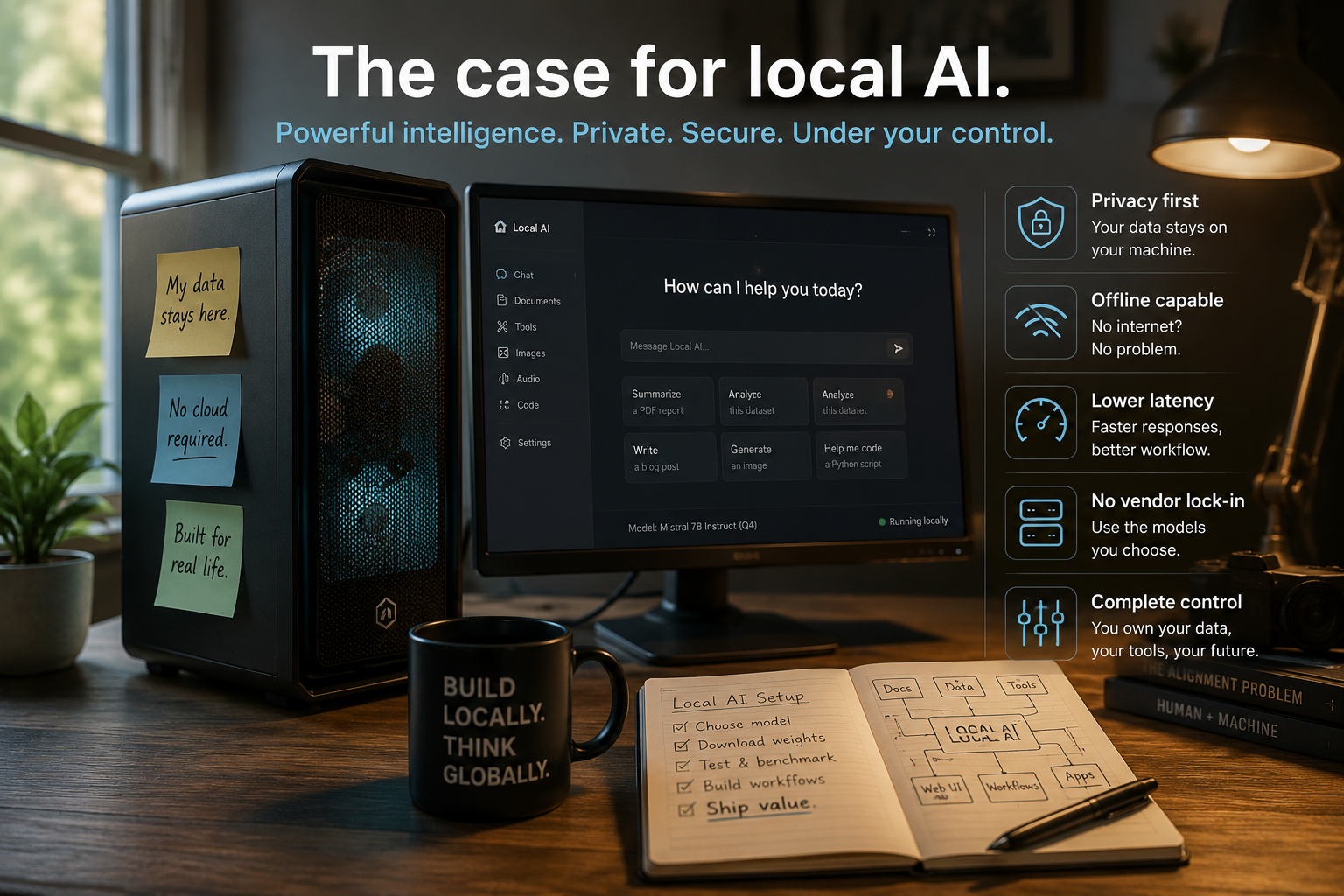
However, these biases are not monolithic or locked in one direction. Different models show different tendencies depending on their training data, fine-tuning, and guardrails. Some lean progressive, others more neutral or even contrarian. Open-source and local models (like Llama, Mistral, Qwen, or Phi) can be further customized by users to reduce unwanted slant.
The idea that AI bias is uniquely dangerous overstates the risk. Humans are biased too. Often far more consistently and emotionally. The real danger comes from over-reliance on any single system, not from AI itself.
Better approaches include:
Generative AI is a powerful creative collaborator. It excels at rapid ideation, drafting, iteration, scaling production, and handling repetitive or tedious tasks like generating variations, marketing assets, or initial prototypes. It can produce derivative and competent work at incredible speed.
However, truly original, emotionally resonant, and culturally meaningful creativity still relies on deeply human elements: lived experience, personal intent, emotional depth, cultural context, moral judgment, and refined taste. AI lacks these. It remixes patterns from existing data rather than drawing from genuine insight or soul.
History supports this view. Cameras didn’t kill painting, they helped birth new movements like Impressionism and street photography. Synthesizers didn’t end music, they expanded what musicians could create. The same pattern is unfolding with AI. Many artists, writers, musicians, and designers are already using GenAI to move faster, explore more directions, eliminate busywork, and amplify their vision.
Audiences continue to crave human authorship, authenticity, trust, and unique perspective. The most successful creators will be those who master AI as a tool while doubling down on what machines can’t replicate: personal voice, emotional truth, and intentional storytelling.

AI has made high-quality synthetic media far easier and cheaper to produce, so the risk of targeted manipulation, confusion, and erosion of trust is genuine. Especially in the final days before voting.
That said, recent election cycles (including the high-stakes 2024 U.S. and global elections) did not deliver the feared wave of AI-generated content that swung outcomes at scale. Incidents occurred, but they remained limited in measurable impact.
Traditional misinformation channels — partisan media, memes, influencer networks, and longstanding human-driven disinformation — continue to dominate. AI tools sometimes amplify these older tactics, but they haven’t replaced them.
Several factors help mitigate the threat:
Democracy has always struggled with manipulation and falsehoods. From print-era propaganda to social media virality. Generative AI adds new capabilities and urgency, but it doesn’t fundamentally break systems that were already imperfect. Vigilance is essential, yet panic overstates the novelty and underestimates society’s ability to adapt.
U.S. data centers power the internet, cloud computing, and the rapid growth of AI, yet they account for roughly 0.2% or less of national freshwater withdrawals and consumption. Direct on-site water use for cooling is even smaller — often estimated at around 0.04% to 0.05%.
To put this in perspective:
While the national numbers are modest, local impacts can feel more significant in water-stressed regions (e.g., parts of Arizona, Texas, or Virginia) where multiple large facilities cluster. The industry is responding with efficiency improvements, reclaimed wastewater, air/liquid cooling alternatives, and water-positive commitments from major players like Google and Microsoft.
Context matters: AI and digital infrastructure deliver enormous economic and societal value, while water challenges are real but solvable through better siting, technology, and policy. Just as we’ve done with other high-impact sectors.
A large hyperscale data center might withdraw 1 to 5 million gallons of water per day, which naturally makes for scary headlines comparing it to a small town’s usage. However, withdrawal is not the same as consumption.
When viewed nationally, these numbers remain modest relative to other sectors. The industry is actively improving: major players are investing in water-positive goals, alternative cooling methods, and smarter siting to minimize local strain. Local concerns in arid regions are valid and deserve scrutiny, but the blanket “AI is drying up America” narrative often exaggerates scale while ignoring engineering progress and relative impact.
In water-stressed regions such as parts of Arizona, Virginia, Oregon, and Texas, clusters of large data centers can put noticeable pressure on local water supplies and represent a visible portion of municipal demand. These localized impacts deserve serious attention, strong community oversight, and transparent planning.
That said, the scale is often more modest than headlines suggest. For example, data centers in Maricopa County, Arizona (home to greater Phoenix) have been estimated to use roughly 0.12% of total county water, compared to 3.8% for golf courses in the same area.
Key context:
Local challenges are legitimate and solvable through better policy, technology, and siting decisions. They do not justify broad national panic about AI “destroying” America’s water supply. As with past industrial growth, smart management and innovation can address these issues without halting digital progress.
The industry is making fast progress on Water Usage Effectiveness (WUE). Operators are deploying a wide range of improvements, including:
Major players like Google, Microsoft, and Equinix are publicly reporting meaningful reductions in water intensity per kilowatt-hour and per AI workload. Many have set ambitious water-positive goals, returning more water to local communities than they consume.
Importantly, the surge in AI demand is not just increasing water use — it is driving faster innovation in cooling technology and resource efficiency. As models and infrastructure scale, the industry is responding with better engineering rather than simply using more resources.
A large portion of the water impact attributed to data centers is indirect — it comes from the cooling water used by power plants that generate the electricity data centers consume. This isn’t unique to AI or data centers. Every home, factory, office, and EV charger shares this same indirect water footprint.
Here’s the encouraging part:
By driving demand for clean energy, data centers and AI are not only reducing their own water footprint, they’re helping accelerate the transition to a lower-water, lower-carbon electricity grid that benefits everyone.
Robotics series
Latest writing
In this X Article, I look at the coming "ChatGPT moment" for humanoid robots and what it could mean for a hospitality-heavy regional economy. The investment case is enormous, but the community question is more urgent: who captures the gains, and who absorbs the disruption?
Robotics series
The opening piece in my local robotics series looks at why humanoid automation is moving from lab demos into service-heavy economies, and why Southwest Florida should start planning before the transition turns chaotic.
Robotics series · Part 2
A cost-focused look at why the economics of humanoid automation are so hard to ignore, even when robot costs are much higher than optimistic forecasts.
Robotics series · Part 3
A plain-spoken map of the failure modes: chaotic deployment, reactive regulation, and trust collapse when communities wait too long to coordinate.
Robotics series · Part 4
A draft framework for managing automation as a time-limited, voluntary coordination effort that protects businesses, workers, and local stability.
Robotics series · Part 5
A direct response to the hard questions: who pays, what workers gain, how small businesses fit, and why coordination has to start before crisis.
Steal these
Copy-ready prompts for work, learning, creativity, and everyday decisions. Paste into any AI chat, fill in the brackets, and go.
Find the real ask hiding in a fuzzy email, text, or Slack thread.
Walk in prepared when you only have a few minutes to think.
Turn mental clutter into a prioritized action list.
Translate jargon from doctors, contracts, bills, or tech docs.
Say the uncomfortable thing without starting a fight.
A gentle devil's advocate before you commit.
Stop driving in circles on Saturday morning.
When you know the topic but can't start typing.
Where to paste
These all have usable free tiers - no paid plan required to get started. Pick one, open a chat, paste your prompt, and fill in the brackets.